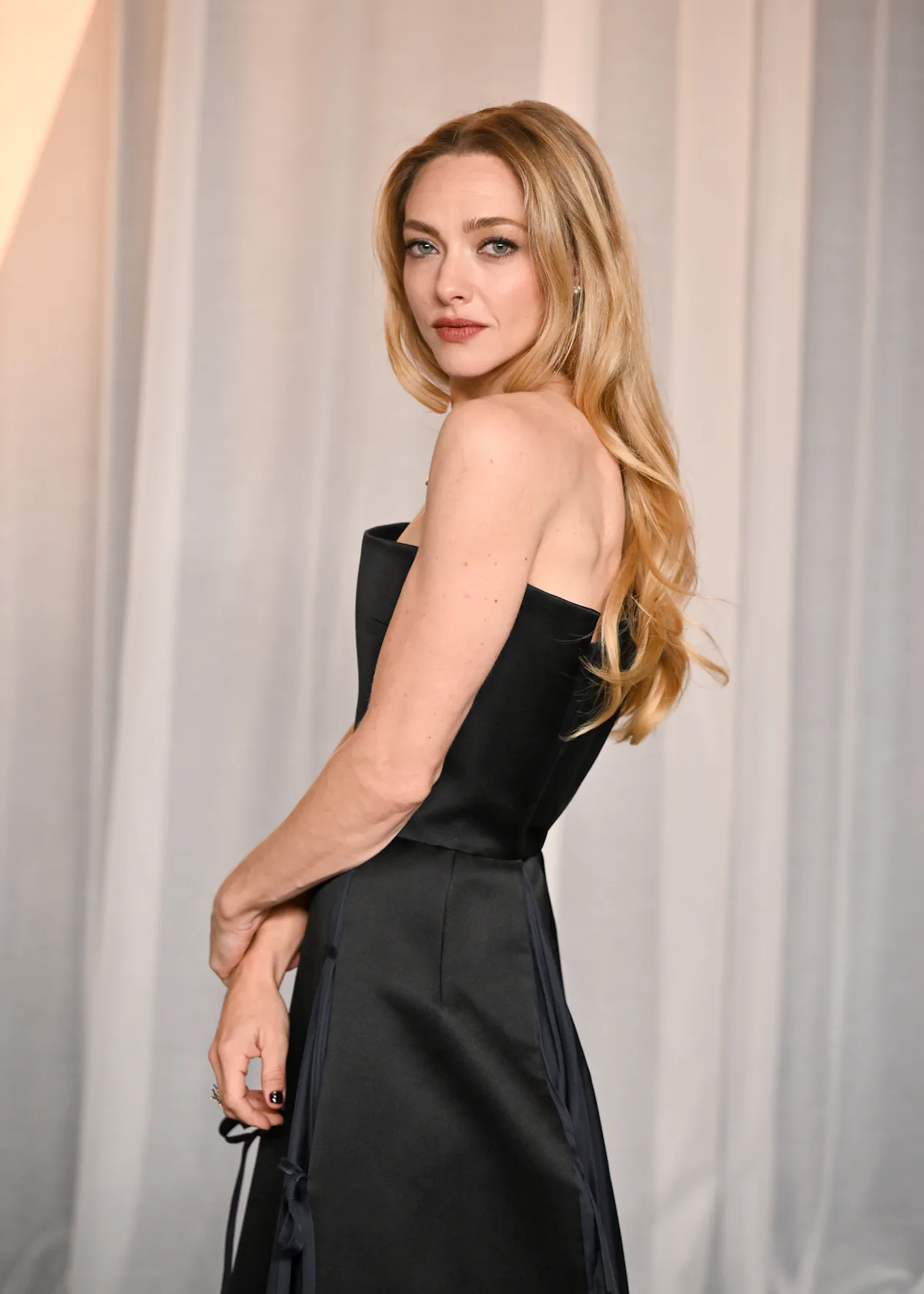
Amanda Seyfried's appearance on *The Tonight Show* in Carolina Herrera's black-and-white floral midi was not a statement in the shouting sense, but rather a quiet recalibration of what an evening look can hold. We have long admired how the actor moves through press cycles with an understated elegance that never feels rehearsed, and this choice, a graphic floral from Wes Gordon's Spring 2027 collection, marking the house's 45th anniversary, felt like a natural extension of that same assured sensibility. For our readers who are already considering their holiday party rotation, this is the kind of reference worth saving. It suggests that the little black dress does not have to be a flat canvas; texture, dimension, and even a hint of sheer transparency can elevate a familiar silhouette without sacrificing its inherent refinement. We explored a similar tension between structure and ornament in our recent piece on Statement dressing at any size, from Fashion Week to holiday soirées, where the balance of bold form and personal comfort became the defining thread. Seyfried's dress operates in that same space, confident without being loud.
What made this particular look so compelling was not the floral appliqué alone, but the way it was handled. The oversized black blooms, each with a crystal center, were arranged in panels that allowed sheer sections to reveal skin in controlled, deliberate intervals. The transparent hem extended just below the skirt, creating a lightness that kept the monochrome palette from feeling heavy or archival. This is not a dress that relies on nostalgia for its impact; it feels present, almost architectural in its precision. Styled by Elizabeth Stewart, the entire composition remained focused, straight center-parted hair, black Christian Louboutin Miss Z mesh pumps with a subtle shine, nothing competing with the dress's own rhythm. It reminded us of the restraint we noted in An afternoon of quiet luxury at Sunset Tower for the Polo Blaze bag, where the luxury was in the details rather than the logo. Here, too, the effect was intentional, not ornamental.
For the holiday season, sequins and velvet will always have their place, but Seyfried's choice opens another lane. The black-and-white palette reads as seasonally appropriate while the floral motif gestures toward spring, a subtle push against the calendar that feels more aspirational than out of place. Gordon's anniversary collection, shown at Lincoln Center's David H. Koch Theater, used graphic color and florals to revisit Carolina Herrera's New York roots, and this dress distilled that celebratory spirit into a single, wearable moment. The practical takeaway for our audience is this: when your go-to evening dress starts to feel predictable, look for dimensional texture, appliqué, cutouts, layered transparency, rather than a new color or silhouette. It is the difference between replacing an old favorite and deepening your relationship with it. Seyfried understood that the floral was not decoration; it was the structure itself.