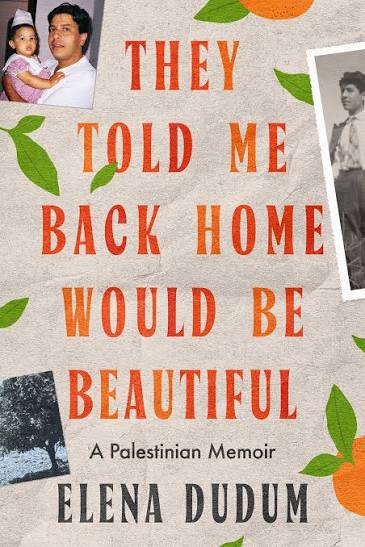
Memory is not a passive archive. It is an act of devotion, a deliberate gathering of fragments against the threat of erasure. Elena Dudum's reflection on building an archive of her ancestral homeland, Palestine, is a powerful meditation on what it means to inherit a place you have never truly inhabited. Her forthcoming memoir, *They Told Me Back Home Would Be Beautiful*, is not merely a family history; it is a quiet confrontation with the politics of visibility. As she clicks through Google Maps, walking the virtual streets of Ramallah and finding Gaza's playgrounds blocked by an absence of satellite data, we are reminded that even digital space is contested. This is a story about the labor of remembering when the world has conspired to make you forget. It asks us to consider how we hold onto beauty, like the stretchy, mastic-laced ice cream from Rukab's, when the land itself has been altered.
What strikes us most is the tenderness in her pursuit, a quality that resonates with the intentionality we often explore in our pages. Just as we might consider a Burgundy made effortless: soft lips and flushed cheeks for fall as a way of curating a mood, Dudum curates an identity from the textures of her family's past. She searches for the street named after her grandfather, Jiries, only to find it renamed. She gently corrects her father's memory of the man being a teacher, knowing the truth is more complicated. These are not acts of destruction, but of preservation. She is weaving a narrative that honors the emotional truth, her father's desire to see himself in a lineage of educators, while also holding the factual record. This is the quiet confidence of someone who understands that identity is built as much from what we choose to believe as from what we can prove. Her father's archive of old magazines, with their colonial-era headlines describing Jewish settlers making the "arid soil bloom," becomes a counter-narrative, a physical collection that insists, "Palestine existed."
The emotional core of this work is not political rhetoric; it is the deeply personal negotiation between a daughter and her father. When she asks him what he loved most about their time in Palestine, he speaks of a young boy winning *Arab Idol* and the orange groves. When she asks for his documents, his voice sharpens: "Are you writing about us?" The tension is palpable. He has spent a lifetime guarding these pieces of proof, and she is the one who must ask for them. This dynamic feels universal to anyone who has inherited a complex legacy. We see it in the way a Generational Ritual for Dry Skin, Derm-Approved is passed down, not as a simple recipe, but as a story of care and survival. Dudum's task is to translate her father's guarded silence and his protective love into a language the world can understand. She takes his text, "I shared them with you. No one else is likely to ever look at them. They're yours," as permission to proceed. It is a sacred transfer of responsibility.
What remains with us is the image of the tree that gives the family its name: the Dudum, whose bark, when cut, weeps a red sap like tears of blood. It is a metaphor for this entire project, an archive built from a wound. The specific takeaway here is that preservation is an act of resistance, but it is also an act of grief. Dudum is not just cataloging a homeland; she is mourning its loss in real time, one Google Maps click at a time. The question her work leaves open is one we must all sit with: What does it mean to inherit a story so heavy that the very act of telling it can feel like a betrayal, and yet, what is the cost of silence? Her answer, for now, is the book itself, a concrete offering that proves the land was never empty, and that devotion, however complicated, is its own form of homecoming.