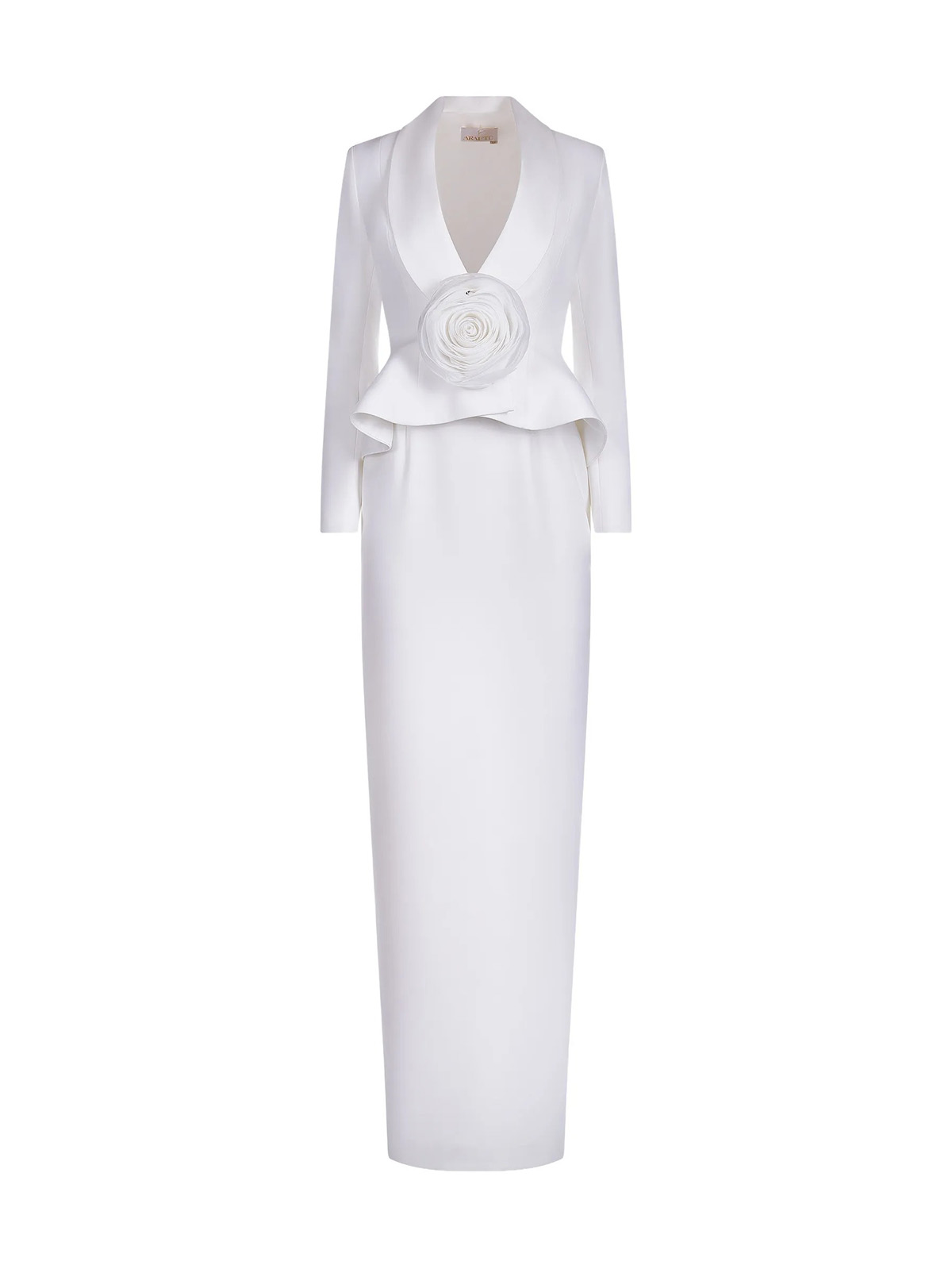
There is something quietly radical about a bride who refuses to be defined by a single dress. The autumn 2027 bridal collections, fresh from New York, suggest we have moved past the era of the one perfect gown into something far more intentional: a wedding wardrobe built for the many versions of a woman. From architectural florals at Pnina Tornai and Monique Lhuillier to the sculptural hips at Abel Honor and Nadia Manjarrez, designers are no longer designing for a moment but for a mood that shifts across days. This feels less like a trend and more like a permission slip, one that allows the bride to be both the romantic and the rebel, the minimalist and the maximalist, without apology. It echoes the same quiet confidence we see emerging elsewhere in style, much like The French Bob Replaces Long Layers as the New Quietly Confident Cut or The Parisian jacket that quietly makes denim feel intentional, a refusal to shout for attention, yet an unmistakable presence.
What struck us most was how this expanded approach to bridal dressing mirrors a deeper cultural shift: the pressure to find "the one" in any context, whether a partner, a career, or a dress, is finally loosening its grip. Dua Lipa's courthouse skirt suit and her subsequent Sicilian rotation of Versace, Chanel, and Bottega Veneta is not an outlier; it is a signal. The wedding weekend has become a series of fashion moments, each one an opportunity to express a different facet of the self. Designers like Kyha, Francesca Miranda, and Cinq are responding with pieces that feel lifted from ready-to-wear collections, vintage-inspired slip dresses, fitted jacket-and-skirt sets, halter tops paired with capri pants. The message is clear: the ceremony gown is no longer the climax; it is simply one chapter in a longer story. This is not about excess for its own sake, but about giving the bride permission to evolve across the celebration, to be seen in her entirety.
The craftsmanship on display reinforces this sense of personal significance. Lace, bridal fashion's most familiar material, has been reimagined as a structural element rather than mere decoration. Vivienne Westwood introduced Rose Lattice and Scattered Roses Cordonnet Lace, while designers like Marmar Halim and Floure devoted themselves to intricate handwork that elevates each gown into a wearable archive of artistry. The cat-eye neckline has returned, but its curve is softer, more knowing, a nod to the early twentieth century that feels entirely of the moment. And the bridal palette continues to soften, with dusty pinks and blush tones offering warmth and personality without sacrificing the sense of occasion. These are not dresses for the bride who wants to disappear; they are for the woman who knows exactly who she is and wants her clothes to reflect that clarity.
The practical takeaway is this: if you are planning a wedding for 2027, stop looking for a single dress and start curating a collection. The most memorable brides will be those who treat their celebration as a series of fashion dialogues rather than a monologue. Watch how the architectural floral trend evolves beyond the runway, it is the detail most likely to define the season's most photographed gowns, precisely because it refuses to be subtle.