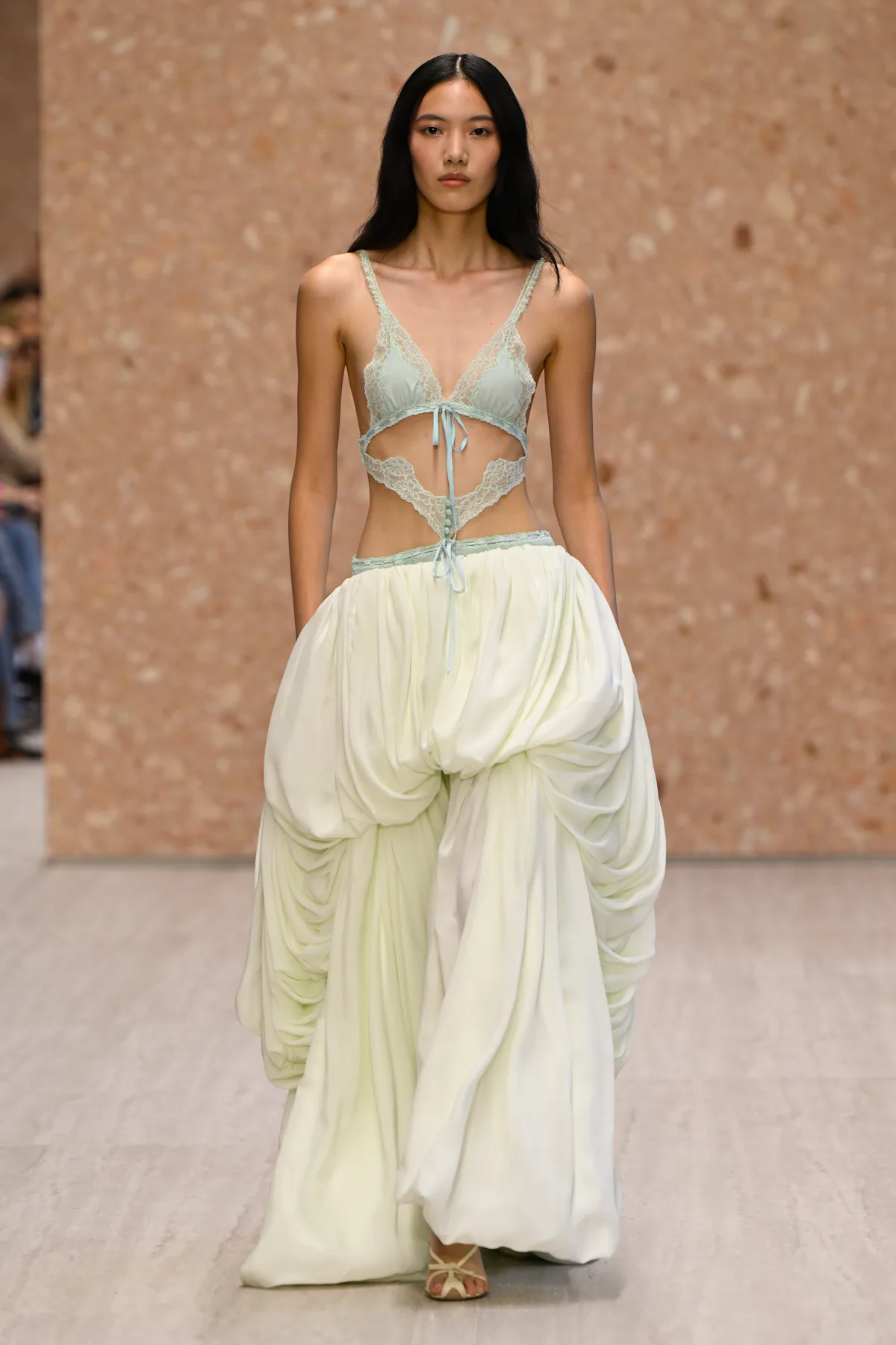
There is something quietly radical about calling an obsession a good thing, especially in a culture that tells us to curate, edit, and keep our desires in check. Chemena Kamali, Chloé's creative director, did exactly that for Spring/Summer 2027, framing her many style fixations not as clutter but as the very engine of the collection. We find this reframing refreshing, not because obsession is inherently virtuous, but because Kamali treats it as an invitation to depth rather than excess. For our readers, who navigate a world of constant visual noise, this distinction matters: taste is not about having fewer influences, but about knowing which ones to follow all the way down. The collection itself is described as quiet, a word that echoes through the show notes and the imagery. It is a fitting choice. Quiet does not mean timid; it means the confidence to let the details speak without raising the volume. Kamali's approach mirrors the kind of self-assuredness we see in Hailey Bieber's gold moment sets the tone for holiday soirée dressing, where a single statement piece sets the entire mood without needing to compete for attention. Both women understand that restraint is the most powerful form of presence.
What makes Kamali's stance feel particularly of this moment is how it aligns with a broader cultural shift toward intentionality. We are no longer rewarding the frantic accumulation of trends; we are rewarding the person who can explain why a certain silhouette, texture, or memory matters to them. Kamali's obsessions are personal, deeply rooted, and openly admitted, and that vulnerability is exactly what gives the collection its quiet authority. It is a form of confidence that does not need to prove itself. This same interior focus appears in Olympic Strength Begins in the Mind for Ilona Maher, where an Olympic medalist grounds her physical discipline in mental clarity. In both cases, the external result, a dress, a performance, is secondary to the internal foundation that produced it. For our readers, the takeaway is practical: before you build your look, your home, or your career, ask what you are actually obsessed with. The answer is your compass.
The risk, of course, is that obsession can curdle into dogma. Kamali avoids this by keeping the collection light, breathable, and spring-appropriate. There is no heaviness here, no insistence that you must adopt her obsessions as your own. Instead, she invites you to witness her process and take what resonates. That generosity is the mark of a true muse, she does not guard her inspirations; she shares them freely, trusting that her audience is sophisticated enough to filter. We are reminded of How Tate McRae Channels Her Next Era Through Scent and Sound, where the singer uses perfume and music as a sensory language to signal a new chapter without stating it outright. Kamali does the same: her obsessions are the scent notes and the chord progressions of the collection, and we are left to feel the composition rather than dissect it.
One specific detail to watch is how this collection lands on the women who actually wear it. Quiet spring collections can sometimes vanish into the seasonal cycle, remembered only by editors and archivists. But Kamali's work has a texture that resists that fate. Her obsessions are tactile: a particular drape, a certain collar, a fabric that moves like water. If those details translate into pieces that women reach for again and again, then the quiet will have done its job. The question is not whether the show was beautiful, it was, but whether the obsessions she poured into it will settle into someone's wardrobe as a daily companion. That is the only measure that matters.