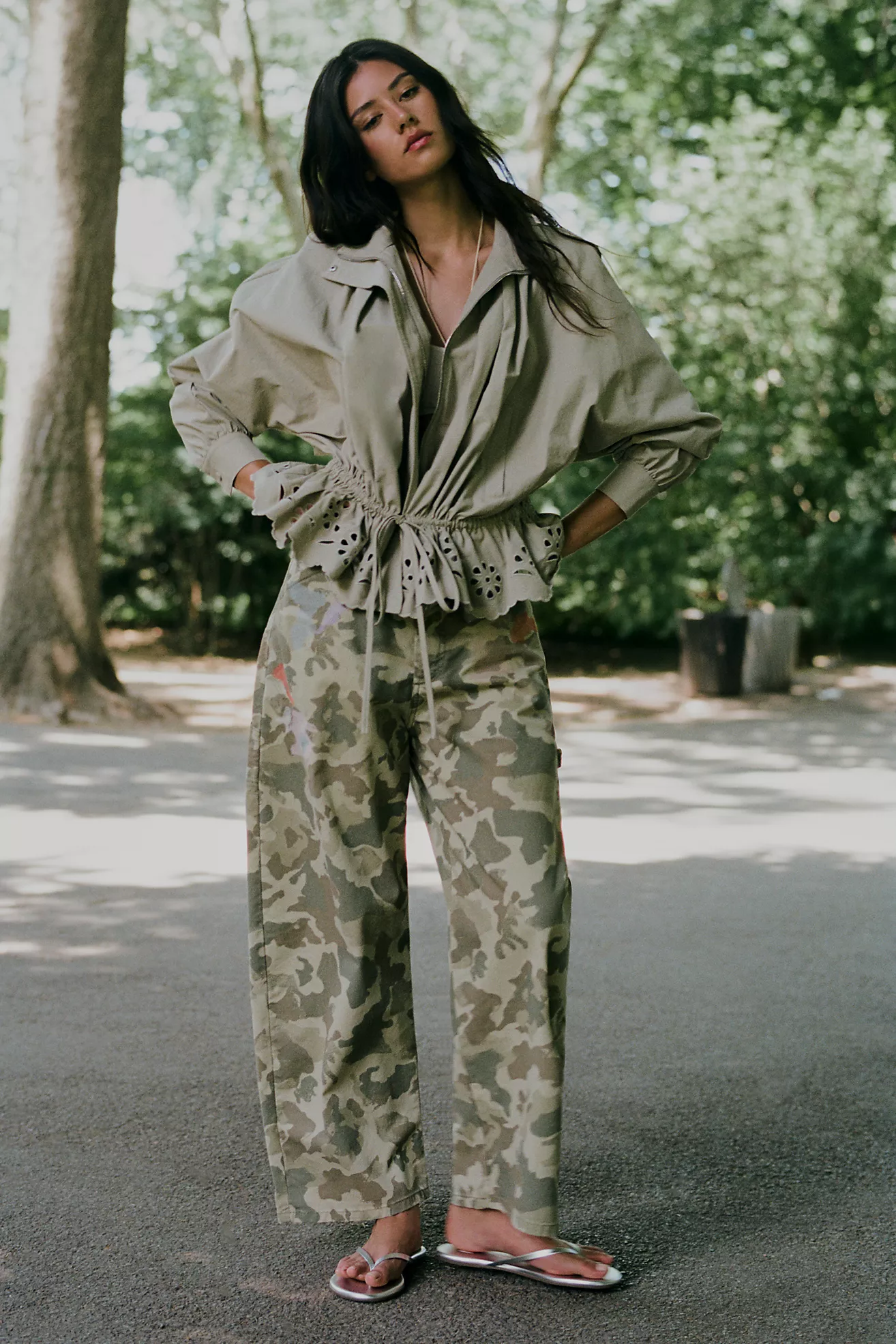
There is a particular pleasure in watching a woman who knows exactly what she is doing, even when what she is doing is wearing something she supposedly would not. For years, the fashion world has delighted in cataloguing Alexa Chung's preferences, the uniform of a modern muse who has never needed to raise her voice to make an impression. So when the conversation turns to camouflage, a print often relegated to the realm of the aggressively casual, the instinct is to assume it is a step too far. And yet, the reporting suggests otherwise. The surprise is not that she wore the trousers, but that she wore them with such an air of quiet inevitability that one wonders why we ever doubted the pairing in the first place. It is a masterclass in a certain kind of style intelligence, one that does not chase a trend but rather absorbs it, digests it, and re-emerges looking entirely like itself.
This is the through-line that connects her approach to the broader currents of the season. We see it echoed in the way J.Lo trades her signature bodysuit for tailored ease in Milan, a shift from the overtly sculpted to the softly structured. It is also present in the quiet subversion of the quiet-luxury shade replacing the classic neutrals you own, a choice that whispers rather than shouts. The through-line is not about the specific garment, be it a pair of camo trousers or a tailored blazer. It is about the confidence to make the garment submit to your personal narrative, rather than the other way around. We are not talking about the loud, logo-heavy flex of a previous era. We are talking about a more internalised, assured sense of self that allows for a print like camouflage to be worn without a hint of irony or aggression. It is the difference between wearing clothes and inhabiting them.
For our reader, the practical takeaway is less about copying Chung's exact outfit and more about adopting her posture. The question is not "Should I buy camo?" but rather "How do I wear the things I already own with a fraction of her self-possession?" The mistake is to view style as a series of rules to be followed, a checklist of approved items. The more sustainable approach, and the one that feels increasingly relevant, is to view it as a vocabulary. You are not starting from scratch; you are reacquainting yourself with the words you already know and giving them a new sentence. It is the same instinct that allows a woman to throw a structured coat over a slip dress, or to pair a chunky sole with a silk skirt, without it looking like a costume. It is a matter of intention, of treating your wardrobe as a personal archive rather than a battlefield.
What we would tell a reader who asks us about this moment is simple: do not look at the trousers. Look at her hands, her posture, the ease of the gesture. That is where the real lesson lies. The garment is incidental; the confidence is the point. And as we move through a season that increasingly values the personal over the prescribed, that is a detail worth watching. The open question is not whether this print will stick, but whether we can carry that same sense of internal calm into our own closets, and let our choices speak with the same quiet authority.