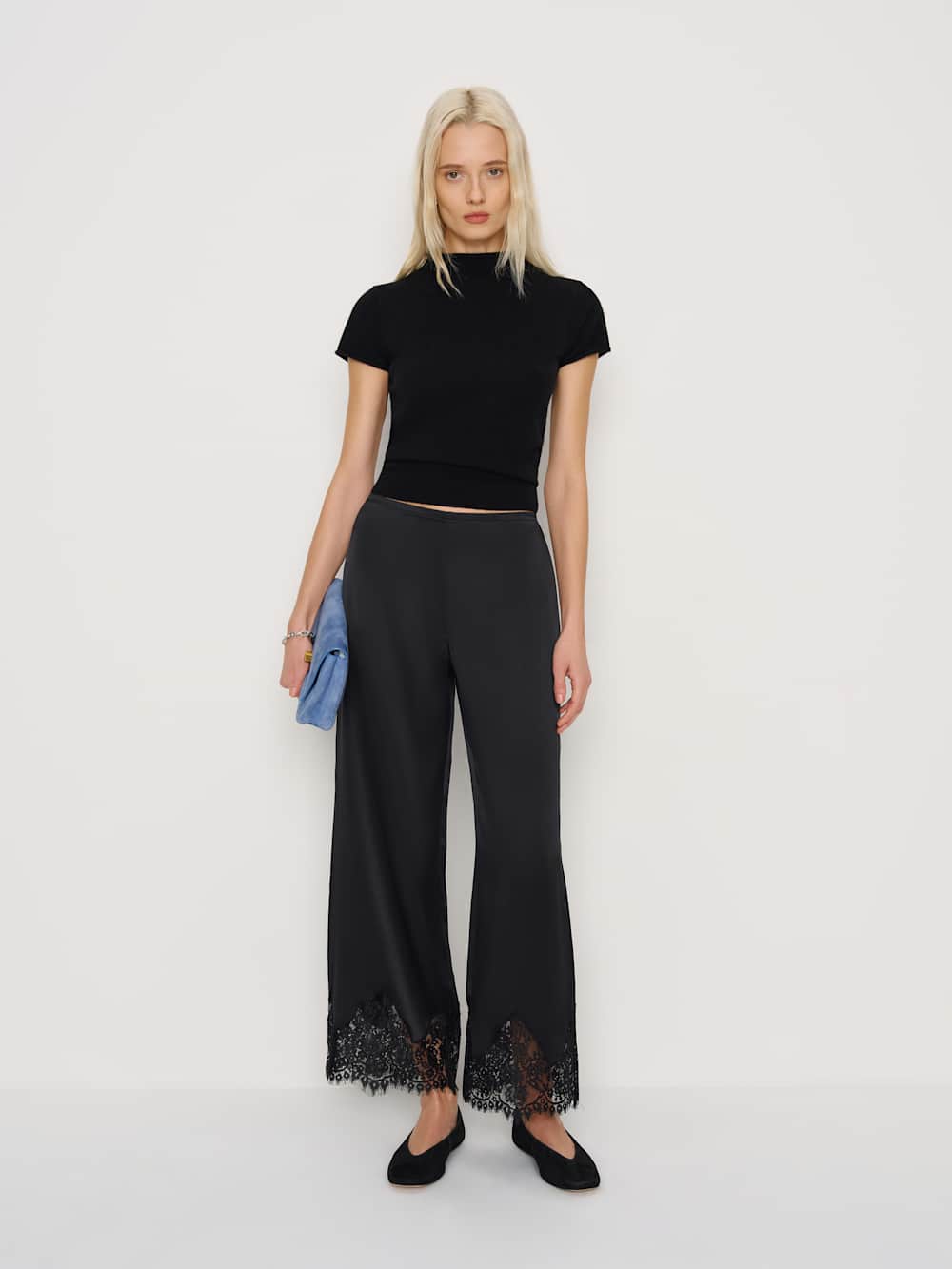
There is a particular kind of confidence that arrives when a woman stops asking a garment to prove itself and starts letting it simply exist. The recent argument for pairing tailored trousers with ballet flats makes that case beautifully. The piece does not beg for attention or chase a trend; it observes a quiet truth. Wide-leg trousers, cropped hems, and fluid fabrics create a line that elongates and softens simultaneously, while the flat grounds the whole silhouette in ease. It is not about dressing down a suit. It is about understanding that polish does not require elevation. This feels like a natural extension of the October Edit: The Quiet-Luxury Staples Defining the Season, where the focus is on pieces that carry weight without shouting. Here, the trouser is the anchor, and the flat is the quiet rebellion against discomfort masquerading as style.
We have all been there, standing in front of a mirror in a sharply tailored pair of trousers, reaching for the heel that will add two inches and a certain posture. The article suggests we abandon that reflex. The magic, it argues, is not in the height but in the intention. When you pair a fluid, high-waisted trouser with a slim ballet flat, you are making a statement about your own priorities. You are saying that your day belongs to you, not to the ache in your arches. This is the same sensibility explored in The Quiet Art of Asking: A Space for Style's Unfinished Thoughts, where the conversation is less about rules and more about personal resolution. The takeaway is not that jeans are obsolete; it is that the right trouser can make a flat look deliberate rather than lazy. It is a lesson in proportion and in trusting that a clean line does the heavy lifting.
What resonates most is the emotional shift this pairing represents. There is a freedom in not performing for the mirror. The article's conviction is not loud; it is the calm assurance of someone who has found a uniform that works. For our readers, the practical application is simple: seek trousers that skim the ankle or graze the top of the foot. Look for a slight crop or a taper that does not pool at the hem. The flat should disappear, acting as a neutral base rather than a competing element. This is not a trend to watch; it is a habit to adopt. We would tell anyone asking that the secret is in the fabric's drape and the trouser's rise. A stiff fabric will fight the flat; a fluid one will move with it. This is about choosing a trouser that holds its shape without needing a heel to give it life. Consider the From Alpine Beginnings, a Style Sensibility Begins to Bloom context, where a sensibility grows from simplicity. The same logic applies here: start with a foundation that feels honest, and the styling becomes an afterthought.
The concrete point to watch is the hem. The entire effect hinges on that small decision. A hem that is too long turns the flat into a trip hazard. A hem that is too short breaks the line. The next time you reach for a tailored pair of trousers, pause before grabbing the heel. Let the flat make the argument for you. It is the most convincing case for comfort you will ever wear.