Hushpitality Is Travel’s Biggest Luxury Trend — These Hotels Are Leading The Way
Our take

The travel landscape is perpetually shifting, and the emergence of "hushpitality" as a defining luxury trend feels particularly resonant in our current moment. After years of relentless hustle and the performative travel narratives often dominating social media, a collective desire for quietude and restoration is undeniably growing. Hotels are responding, and rightfully so. This isn't merely a fleeting fad; it speaks to a deeper cultural yearning for intentional disconnection and mindful experiences, a desire that aligns perfectly with the growing appreciation for "quiet luxury" aesthetics, much like the timeless hair color trends highlighted in 6 Timeless Hair Color Trends That Suit Everyone—From Cowboy Copper to Quiet Luxury Brunette. The shift away from jam-packed itineraries and towards restorative retreats represents a profound recalibration of what luxury truly means. It’s less about displaying wealth through conspicuous consumption and more about investing in personal well-being and cultivating a sense of serenity. This echoes a broader movement towards prioritizing inner peace and authenticity, a concept explored in greater detail within the fashion sphere, as showcased in The June Fashion News You’ll Want To Bookmark.
The core concept of hushpitality—prioritizing rest, recovery, and quietude—is particularly compelling because it subverts the traditional travel narrative. For too long, the expectation has been to maximize every moment with activities, excursions, and the constant documentation of experiences for social media. This constant stimulation can be exhausting, and the resulting burnout is palpable. Hushpitality offers a counterpoint: a space to simply *be*, to disconnect from the digital world and reconnect with oneself. The design and programming philosophies behind these hotels are therefore crucial. They extend beyond minimalist aesthetics – although that’s certainly a component – to encompass sensory experiences that promote calmness: soundproofing, curated lighting, nature-inspired elements, and programming centered around mindfulness and wellness. It’s a holistic approach that recognizes the profound impact of environment on mental and emotional state. Furthermore, the rise of hushpitality demonstrates a sophisticated understanding of the modern traveler’s needs; it acknowledges that true luxury isn't just about opulent amenities, but about providing a sanctuary from the stresses of daily life. The emphasis on well-being is also mirroring a wider cultural conversation around self-care, as evidenced by the surprisingly practical advice found in The Internet Is Full of Hickey Hacks—Experts Say These Tips Actually Help, demonstrating a broader interest in mindful practices, even in unexpected areas.
The implications of this trend extend beyond the hospitality industry itself. Hushpitality signals a broader shift in consumer values, a move away from superficial displays of wealth and towards experiences that nourish the soul. It's a reflection of a generation that is increasingly attuned to the importance of mental health and well-being, and that is actively seeking ways to prioritize self-care. This also presents a significant opportunity for brands across various sectors – from wellness and beauty to fashion and design – to align with this emerging ethos. The aesthetic associated with hushpitality—minimalist, refined, and understated—is inherently luxurious, but it’s a luxury that is rooted in authenticity and intention. It’s a far cry from the ostentatious displays of wealth that have historically defined the luxury market. It also allows for a deeper level of personalization, as hotels can tailor their offerings to meet the specific needs and preferences of their guests, fostering a sense of genuine connection and belonging.
Looking ahead, it will be fascinating to observe how hushpitality evolves and adapts. Will it become a permanent fixture in the luxury travel landscape, or will it eventually fade as another fleeting trend? Perhaps the most compelling question is whether this focus on quietude will inspire a broader cultural shift towards prioritizing inner peace and mindful living, even beyond the realm of travel. The demand for restorative experiences is unlikely to diminish anytime soon; the way hotels respond—and the extent to which they genuinely embrace the principles of hushpitality beyond surface-level aesthetics—will ultimately determine its long-term success and its impact on the future of luxury.

A new era of travel is emerging — one defined less by itineraries packed with activity and more by intentional absence. Hotels are responding with what can best be described as “hushpitality”: a growing design and programming philosophy centered on rest, recovery, and quiet as the ultimate luxury. According to Hilton’s 2026 Trends Report, 63% of travelers now say downtime is their primary reason for traveling, signaling a decisive shift away from stimulation and toward restoration. That desire is increasingly structured into how trips are built, with nearly half of travelers intentionally adding solo days to their itineraries purely for peace and solitude (heck yes).
The data points to a broader recalibration of what travel is meant to do. The leading motivations for leisure travel in 2026 are rest and recharge (56%), spending time in nature (37%), improving mental health (36%), and spending time alone (20%). Even within group travel, quiet is becoming non-negotiable — 28% of jet-setters now seek solo moments while traveling with others, carving out space for themselves inside shared itineraries (it’s called bed rot time…). Planning behavior is also shifting toward ease and reduction: 66% of travelers with children or grandchildren prefer vacations that require minimal planning, favoring all-inclusives, cruises, and group formats that reduce cognitive load.
Perhaps most telling is the cultural openness to structured quiet itself. More than half of U.S. travelers (57%) say they would be interested in attending a silent retreat, with 53% specifically drawn to reading retreats. This signals a deeper desire not just to relax, but to actively remove noise — digital, social, and environmental — from the travel experience altogether.
In response, hotels are evolving into environments that do more than host guests — they actively lower stimulation. From soundproofed sanctuaries and sleep-optimized rooms to nature-immersed retreats and silent programming, hushpitality is reshaping the modern stay into something quieter, slower, and far more intentional. Here, some of the best stays to experience the trend.
Conrad Athens, The Ilisian: Athens, Greece

Recently opened as a flagship within Hilton’s Conrad portfolio, Conrad Athens The Ilisian marks the transformation of the former Hilton Athens into a contemporary urban resort with approximately 278 rooms and suites. The reopening positions it as one of the city’s most significant new luxury hotel launches, blending scale with a deliberately restrained, residential sensibility.
Designed through a “hushpitality” lens, the property softens the intensity of its central Athens location by creating a self-contained environment of calm. Expansive wellness facilities, resort-style outdoor areas, and multiple on-site dining concepts reduce the need to re-engage with the city’s noise, while the hotel’s large footprint disperses foot traffic and creates pockets of stillness throughout the property. Guest rooms emphasize light, space, and muted modern finishes, reinforcing a sense of quiet separation from the urban core. As a newly opened urban retreat, Conrad Athens functions as a recovery-focused anchor in the city — prioritizing rest, spatial ease, and controlled calm within a high-energy destination.
Hotel The Mitsui Kyoto: Kyoto, Japan

Hotel The Mitsui Kyoto is a 160-room ultra-luxury property under Marriott’s Luxury Collection, set on a 250-year-old former Mitsui family estate beside Nijo Castle, a UNESCO World Heritage Site. Designed to reflect harmony across the seasons and five senses, the hotel leans into a restrained, culturally grounded sense of calm through natural materials, soft light, and quiet spatial flow.
Its restorative focus is expanding further with a new onsen-based healing and sleep journey launching in 2026, which centers on thermal spring bathing, guided relaxation, and sleep-enhancing rituals aimed at improving rest quality. Combined with its existing wellness programming — natural hot spring bathing, a modern tea ceremony alcove, and slow, sensory-driven dining — Hotel The Mitsui Kyoto positions itself as a cultural wellness retreat where rest is structured through tradition, environment, and sleep-focused experiences rather than overt stimulation or programming.
Six Senses Ibiza: Ibiza, Spain

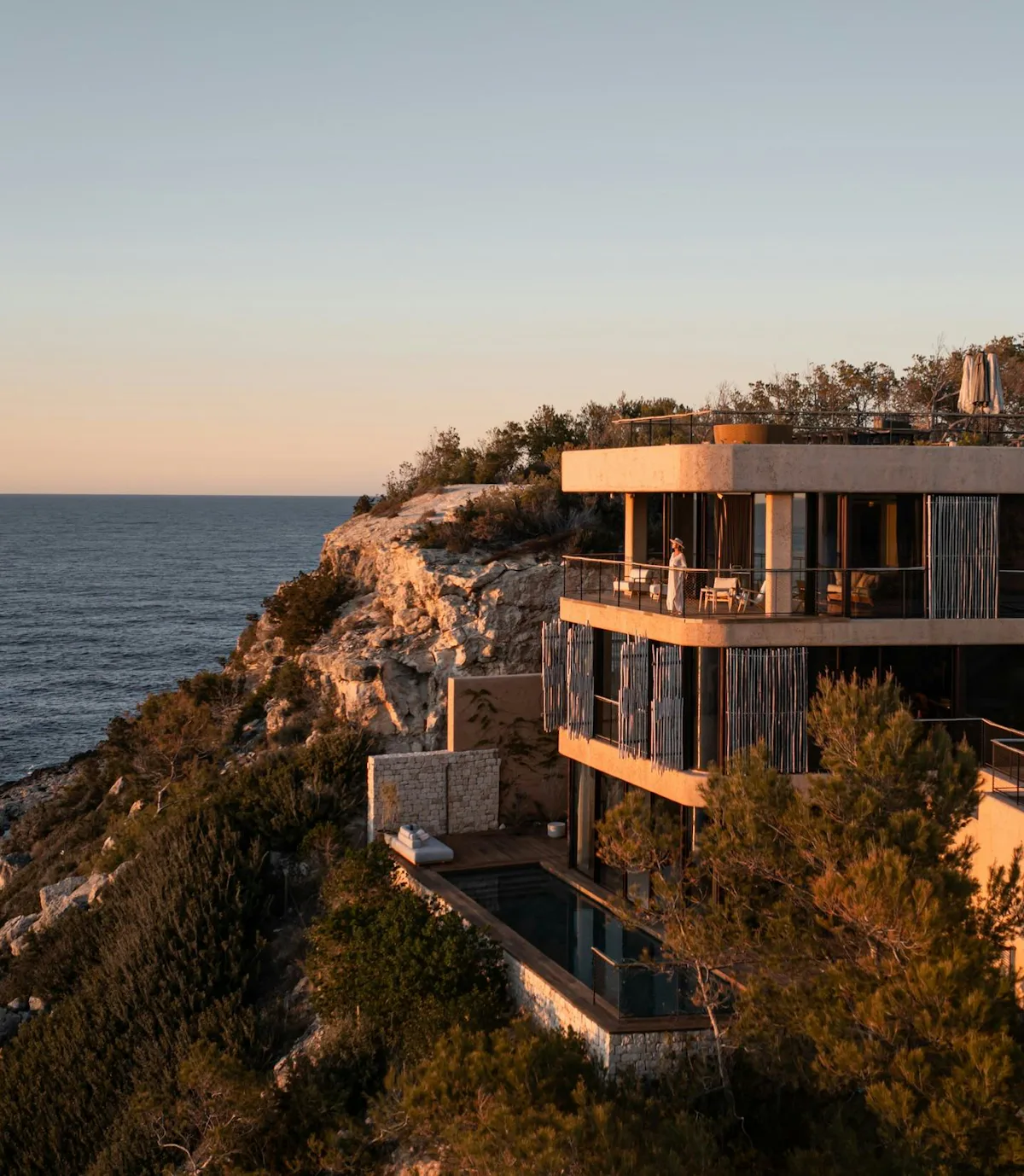
Six Senses Ibiza is a 137-room coastal wellness resort set on the island’s quieter northern edge in Cala Xarraca, part of the Six Senses Hotels Resorts Spas portfolio (under IHG). Built into the cliffs and pine forest, the property leans into biophilic design — stone, wood, and open-air layouts that blur indoors and outdoors, naturally dialing down stimulation from the moment you arrive.
Its restorative focus is anchored by a large-scale spa and longevity center that pairs holistic therapies with modern recovery tools, from sleep optimization programs and meditation to biohacking treatments and nervous system reset rituals. Even at its most social, the resort is structured with intentional separation — quiet zones, private terraces, and wellness-led programming that lets guests oscillate between connection and complete decompression without ever leaving the property.
Le Taha’a by Pearl Resorts: Le Taha’a, French Polynesia

Le Taha’a by Pearl Resorts is a 5-star Relais & Châteaux property set on a private motu between Taha’a and Bora Bora, with just about 58-60 suites and villas, making it one of French Polynesia’s more intimate luxury stays. Accessible only by boat from Raiatea, the resort feels deliberately removed from anything fast-moving, surrounded instead by a still lagoon, reef edges, and open horizon.
The experience is built around natural quiet: overwater bungalows and beach villas are spaced for privacy, with low-density pathways and direct lagoon access that encourage slow, unstructured days. Wellness is integrated rather than layered on, with a spa tucked into tropical gardens and treatments rooted in traditional Polynesian techniques, reinforcing the island’s rhythm of ease and restoration. Even the setting itself does most of the work — water, wind, and light become the dominant sensory experience, not programming or activity.
Masseria Torre Maizza: Puglia, Italy

Masseria Torre Maizza is a 5-star Rocco Forte property set within a restored 16th-century farmhouse surrounded by ancient olive groves on the Adriatic coast. The hotel blends boutique scale with residential-style privacy, designed by Olga Polizzi to feel like a refined Puglian hideaway rather than a conventional resort.
Its sense of calm comes from pace and place: low-density grounds, vine-covered courtyards, and rooms that open onto olive trees or private gardens naturally slow the rhythm of a stay. Interiors lean into soft, earthy tones and local materials like Trani stone, reinforcing a muted, grounded aesthetic that quiets the visual field. Wellness is integrated through a spa, golf course, and private beach club access, encouraging guests to move between stillness and light activity without leaving the property’s cocooned environment. The result is a coastal masseria where restoration is built into the landscape itself.
Four Seasons Tamarindo: La Manzanilla, Mexico

Four Seasons Tamarindo is a 157-room resort set within a 3,000-acre private nature reserve along Mexico’s Costalegre coast, part of the Four Seasons Hotels and Resorts portfolio. Designed as a low-density escape, accommodations are spread across jungle cliffs, beachfront settings, and standalone villas, all oriented to maximize privacy and uninterrupted views of the Pacific.
The experience is defined less by programming and more by physical removal from stimulation. Private terraces, plunge pools, and expansive indoor-outdoor layouts keep guests in line with nature and quiet, while the vast surrounding reserve turns jungle and ocean into the dominant sensory field. With wellness, dining, and beach access distributed across the landscape, movement is intentionally slow — making rest feel embedded in the geography rather than scheduled into the stay.
Alila Napa Valley: St. Helena, California

Alila Napa Valley is a 64-room adults-only retreat set along the vineyard edge of St. Helena, part of Hyatt’s Alila Hotels & Resorts portfolio. Designed by Yabu Pushelberg, the property sits adjacent to a historic estate winery and leans into a restrained, residential style — stone, wood, and glass used in service of the landscape rather than competing with it.
The effect is quiet without trying to announce itself. Rooms open onto private terraces and fire pits facing uninterrupted vines and rolling hills, while interiors stay intentionally muted with spa-like bathrooms and soft, low-contrast finishes. With only 64 accommodations and a layout that favors openness over density, the property naturally slows movement — less about scheduled wellness moments and more about removing anything that pulls attention away from the view.
JW Marriott Scottsdale Camelback Inn Resort & Spa: Scottsdale, Arizona

Camelback Inn stretches across 125 desert acres in Scottsdale, with more than 450 adobe casitas scattered between cactus, stone paths, and wide-open Sonoran sky. A recent $25 million renovation of The Spa at Camelback Inn reframes the property through a more intentional wellness lens, expanding its 32,000-square-foot footprint with updated hydrotherapy, outdoor treatment spaces, and sensory-driven rituals shaped by the desert itself.
What makes it relevant to the hushpitality moment isn’t just scale or spa upgrades — it’s how the resort uses space as a kind of buffer. Casitas are spaced far enough apart that the experience naturally decompresses; there’s a built-in removal from noise, both literal and social. The newly refreshed spa reinforces that same idea, leaning into slower, environment-led treatments that mirror the surrounding landscape instead of overpowering it. The result is a stay that doesn’t push wellness as an agenda, but instead lets quiet accumulate in the gaps between everything.
Avantgarde Refined Yalıkavak: Bodrum, Turkey

Set along Küdür Bay on the Yalıkavak coast, Avantgarde Refined Yalıkavak is a beachfront boutique hotel under the Avantgarde Collection, a Turkish hospitality brand known for design-led, lifestyle-driven stays that sit somewhere between resort and private residence. It feels intentionally removed from Bodrum’s more high-energy marina scene, with a quieter stretch of coastline doing most of the work.
The experience unfolds at a slowed coastal register — direct Aegean access, open-air spaces, and a layout that keeps guests oriented toward sea and horizon rather than interiors or programming. Days stretch easily between still mornings, long hours by the water, and unforced transitions into evening light. It’s the perfect place to quiet the mind and actually relax.
Rancho La Puerta: Tecate, Mexico

Just an hour from San Diego, Rancho La Puerta spans 4,000 acres of mountains, gardens, and open desert, operating less like a resort and more like a wellness village built into the landscape. Guests stay in simple casitas scattered across the property, where the emphasis is on ease, movement, and time spent outdoors rather than a traditional hotel feel.
Its newest focus on Silent Retreats and Quiet Programming formalizes what the property has long been known for: structured disconnection. Days move between meditation hikes, breathwork, mindful trail walks, and water-based therapies, with silence woven directly into the experience through moments like silent dinners that shift something as familiar as a shared meal into a more reflective, grounded pause. Everything here is designed to dial down input — social, digital, sensory — so that attention can settle somewhere quieter.
Shou Sugi Ban House: Hamptons, New York

Shou Sugi Ban House is a 13-room wellness retreat in Water Mill, part of the Hamptons, designed around Japanese wabi-sabi principles and a pared-back sense of calm. Conceived as a modern sanctuary rather than a traditional hotel, it pairs minimalist architecture with gardens, light-filled studios, and a deliberately restrained atmosphere that keeps stimulation low from the moment you arrive.
The programming is where that quiet becomes experiential. Guests move through hydrotherapy circuits with saltwater plunge pools, saunas, and eucalyptus steam rooms, alongside treatments like Watsu water therapy, shiatsu, lymphatic drainage, and herbal bodywork designed to regulate the nervous system rather than simply relax it. Beyond the treatment rooms, the day continues with yoga, breathwork, meditation, sound healing, and tea ceremonies, often in open-air spaces that emphasize stillness over structure. Even the property’s limited tech environment and emphasis on walking paths and garden meditation reinforce the same idea: uninterrupted calm.
Rosewood Schloss Fuschl: Salzburg, Austria

Rosewood Schloss Fuschl sits on the edge of Lake Fuschl just outside Salzburg, a restored lakeside castle with rooms and suites spread between the historic estate and surrounding boathouses. As part of Rosewood Hotels & Resorts, it leans into its alpine setting in a way that already feels inherently quiet — water, forest, and mountain views doing most of the sensory work.
That sense of ease is sharpened through its “Sleep Well” program, a two- or three-day experience built entirely around rest. Guests move through guided breathwork, gentle movement, and meditation alongside sleep-focused treatments and calming in-room setups designed to make nights feel intentionally deeper and slower. Even meals are adjusted toward recovery, keeping the focus less on wellness as an activity and more on sleep as the organizing principle of the stay.
The Resort at Pelican Hill: Newport, California

The Resort at Pelican Hill is a five-star, five-diamond, 500-acre coastal estate in Newport Beach, part of the Marriott portfolio, known for its low-slung villas and panoramic views over the Pacific. With just over 200 bungalow-style accommodations spread across rolling hills, the property is intentionally expansive, designed more like a private coastal village than a traditional resort.
That sense of space carries through to the Spa at Pelican Hill, a 23,000-square-foot wellness complex that feels almost cathedral-like in its use of water, light, and scale. Roman-inspired saltwater soaking tubs, steam rooms, saunas, and the Acqua Colonnades create an environment where sound drops the moment you enter. Treatments are tailored and rooted in traditional therapies, but the quieter impact comes from the atmosphere itself — open, airy, and slightly removed from the pace of the surrounding coastline.
One&Only Moonlight Basin: Big Sky, Montana

This One&Only opening in Big Sky leans fully into isolation as a design choice, set across a vast Montana landscape where mountains, forests, and wide-open sky do most of the work. It’s part of One&Only Resorts, a brand known for high-touch luxury, but here the focus shifts away from spectacle and toward scale — space that naturally quiets everything down.
What defines it most is the feeling of removal. The resort is built into a landscape where silence isn’t curated so much as already present, and the experience is structured around slowing down rather than filling time. Wellness programming, outdoor immersion, and a strong connection to nature frame the stay, but the real luxury is the lack of interruption.
The Sanctuary Beach Resort: Monterey Bay, California

Set directly on the sand along California’s Central Coast, The Sanctuary Beach Resort is a small boutique property where the Pacific feels less like a view and more like the organizing force of the stay. Dunes, wind, and tide shape the experience as much as anything on the calendar, with rooms positioned to keep attention pointed outward rather than inward.
Programming unfolds in a way that follows that coastal quiet: beachside yoga at sunrise, bonfires as the light drops, and oceanfront dining at Salt Wood Kitchen & Oysterette anchoring the day in a slower register. New offerings like Kintsugi workshops, intuition sessions, and Full Moon gatherings add a more reflective layer without disrupting that ease. The Burnout Recovery Journey threads through it all, designed for guests moving through fatigue or overstimulation, with the coastline itself doing a lot of the work in resetting the pace.
Equinox Hotel New York: New York, New York

Equinox Hotel New York sits in Hudson Yards as part of the Equinox Hotels brand, the hospitality extension of the fitness and wellness company known for performance-driven living. Designed less like a traditional city hotel and more like a controlled recovery environment, it brings a sense of calm engineering into one of the most high-stimulation neighborhoods in Manhattan.
Within the hushpitality landscape, it represents the urban extreme of the idea — quiet that is constructed rather than found. Rooms are designed for sleep optimization, with blackout systems, soundproofing, and circadian lighting that regulates rest and wake cycles. Wellness programming extends that focus through recovery treatments, contrast therapy, and movement practices centered on nervous system regulation. The effect is keeping the city at bay, fully hushed.
Read on the original site
Open the publisher's page for the full experience