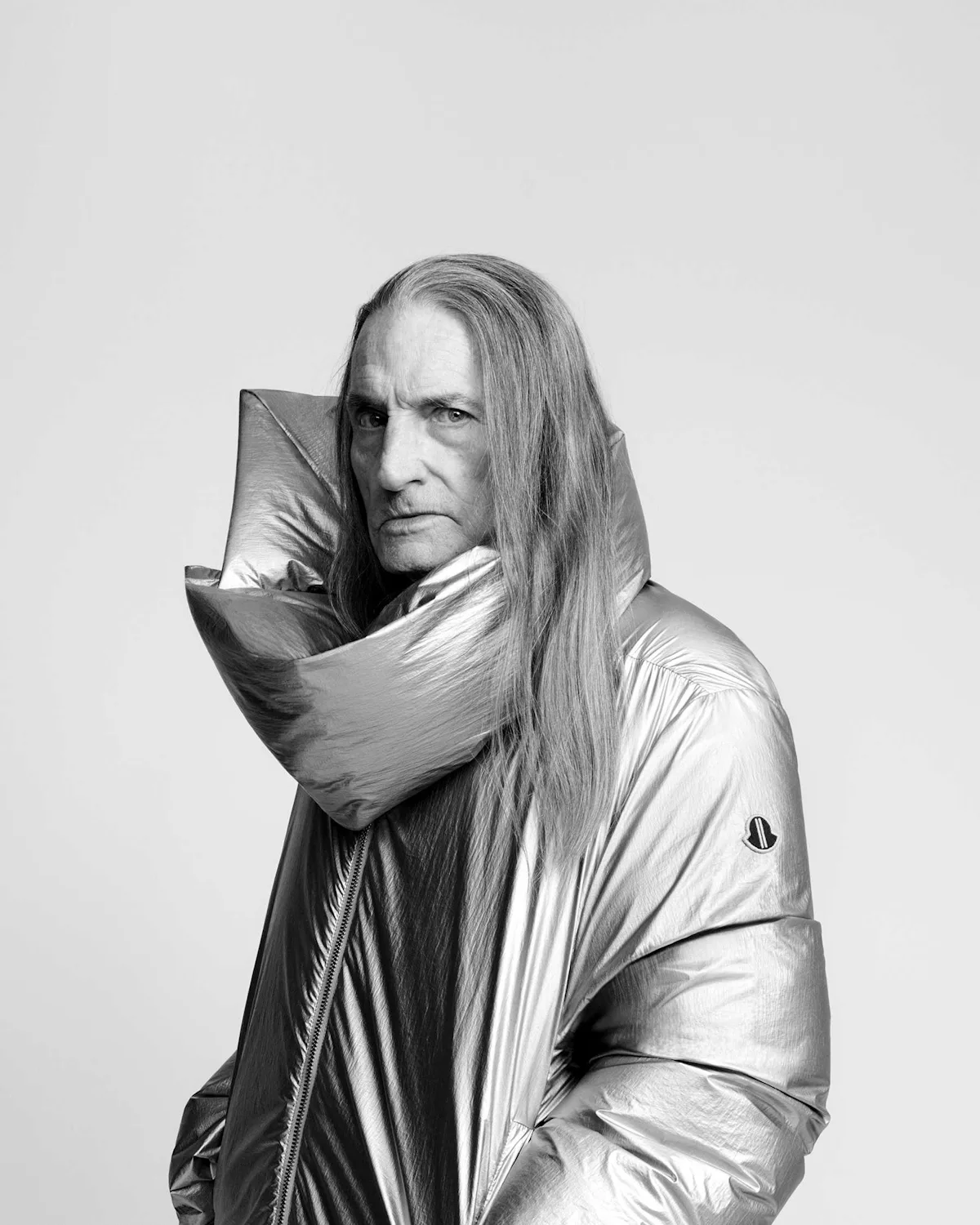
There is something quietly radical about a campaign that lets a face carry the weight of a coat. Rick Owens' latest Moncler collaboration, shot by the designer himself, does exactly that. By placing Joe Dallesandro at the center of a winter collection defined by exaggerated quilting, metal studs, and utilitarian bulk, Owens makes a deliberate choice: the garment is not the story; the person wearing it is. This is a welcome departure from the noise of seasonal drops and hype-driven launches, and for anyone building a wardrobe with intention, it is worth pausing over. The collection itself is unmistakably Moncler in its technical precision and unmistakably Owens in its stark, sculptural sensibility. The palette stays in his familiar territory, black, Palladium, Cloud Grey, Grease, while the silhouettes push beyond the functional into the almost architectural. It is the kind of restrained experimentation that rewards a second look, much like the Plaid and quiet detailing reshape the Converse Chuck 70 we recently covered, where subtle pattern and restrained branding transformed a familiar sneaker into something quietly new.
What elevates this campaign beyond a standard collaboration announcement is the casting. Dallesandro is not a typical fashion figure. He emerged from Andy Warhol's orbit, became immortalized in Lou Reed's "Walk on the Wild Side," and carried a presence that challenged conventions of masculinity and screen stardom without ever being loud about it. Owens, who recalled the song as a turning point for "a lot of other suppressed kids of my generation," understands that resonance intimately. By photographing Dallesandro in black-and-white portraits that echo Richard Avedon's images of Warhol's entourage, he connects the collection to a lineage of subcultural belonging, finding one's tribe on the margins. This is not nostalgia for its own sake. It is a reminder that true style has never been about following trends but about inhabiting a point of view with quiet confidence. It echoes the same self-assured intentionality we saw in Kaia Gerber Dresses the Nightshift in RE/DONE's Quiet Debut, where a collection was built around identity rather than spectacle.
For the reader curating a winter wardrobe that feels personal rather than performative, the takeaway here is specific. The collection's oversized proportions and dark neutral palette offer a way to approach outerwear as an anchor piece, something that can define a silhouette without shouting for attention. The Mega Strap detail, which allows the jacket to be carried when not worn, is a small but telling example of Owens' ability to blend utility with visual weight. It is the kind of detail that rewards those who pay attention. The collaboration does not need to be worn head-to-toe to have impact; a single piece, layered with intention, can shift the entire energy of a look. That is the quiet power of this release: it invites you to participate in a mood, not a uniform.
What remains to be seen is whether this kind of subcultural reverence will translate beyond the niche that already admires Owens' world. But that may be the wrong question. The more interesting one is whether a winter coat, when chosen with the same care Owens applied to his muse, can carry a story as compelling as the one Dallesandro embodies. For those willing to look closely, the answer is already here.