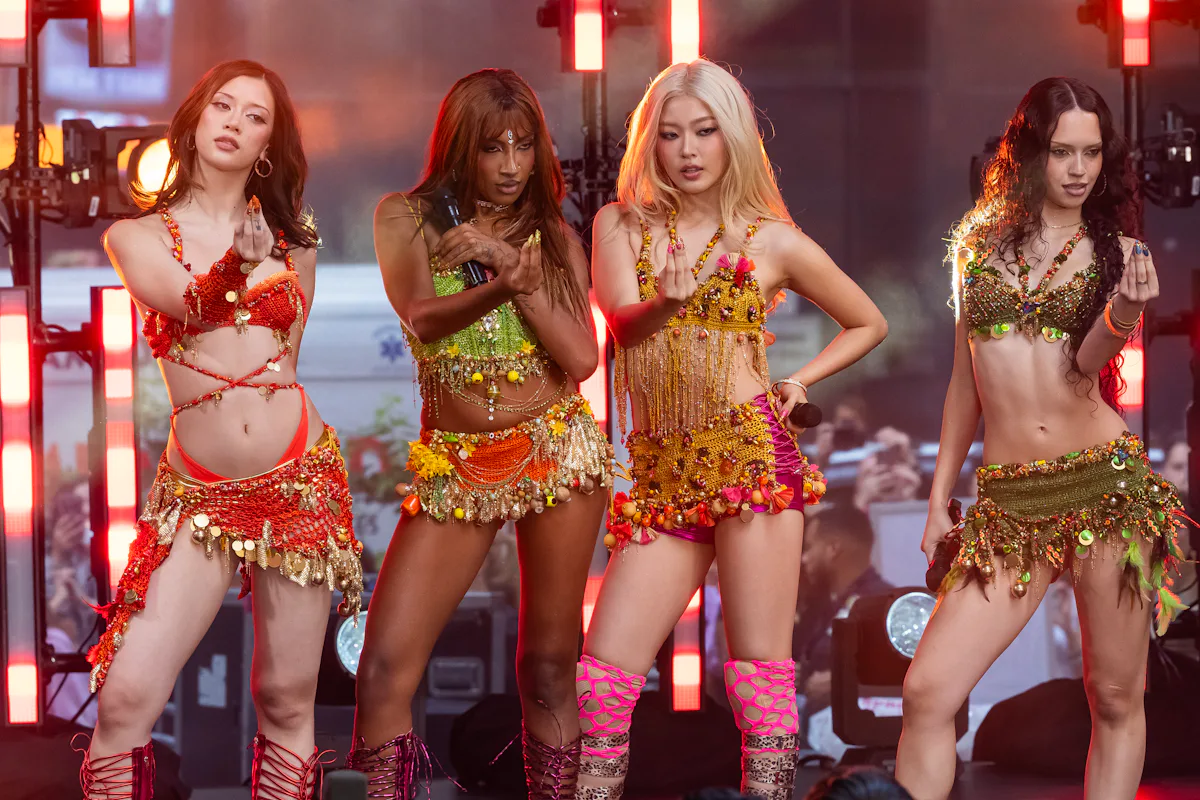
There is something quietly compelling about a group of young women who understand that style is not about the volume of the look but the intention behind it. Katseye's fashion philosophy, as they describe it, is refreshingly self-aware: onstage, they embrace the shine and the spectacle; offstage, they retreat into comfort and ease. This duality is not a contradiction but a sign of maturity. They know that clothes are tools for different modes of being, performance and presence, projection and rest. In an era that often demands a single, polished persona, their willingness to shift between maximalist stagewear and quiet off-duty pieces feels less like a compromise and more like a quiet kind of power. It echoes the same sensibility we explored in The Quiet Poetry of Cold-Weather Dressing, where warmth and texture become their own form of expression, and in The Quiet Code of New York: French-Girl Style Finds Its Calm, where restraint itself becomes a statement.
What makes their approach worth noting is not the individual pieces, the trench coats, the dance heels, the robe from Victoria's Secret, but the way they treat clothing as a lived extension of their creative work. Yoonchae Jeung's reliance on an Aritzia trench coat as a shortcut to chic is not about laziness; it is about knowing what works and trusting it. Lara Raj's discovery of a 2003 Versace lace trench in Amsterdam speaks to a deeper instinct: the best finds are not planned, they are felt. And Daniela Avanzini's insistence on Amsterdam as the superior shopping destination, over New York, no less, suggests a taste that values curation over volume. These are not throwaway observations. They reveal a group that has already internalized what many spend years learning: that personal style is less about acquiring and more about discerning. The fact that they share clothes on tour, naturally gravitating toward a shared edgy palette, only reinforces the idea that style can be collective without being uniform.
The practical reality behind their polished performances is where the story deepens. Megan Skiendiel's discovery that Super Stick tape could hold a bikini top in place during an intense dance break is not a trivial detail, it is a reminder that for women who move for a living, fashion must earn its place on the body. The attention to shoelace length, grips, and the shift from flats to dance heels is not vanity; it is preparation. These are the quiet, unglamorous choices that make the glittering moments possible. It is the same intentionality that defines any thoughtful relationship with dressing: the understanding that what you wear must serve the life you are actually living, not the one you are merely posing for.
And then there is the Gucci question. When Raj, Avanzini, and Skiendiel name Demna's Gucci as their shared aspiration, it lands with a specific weight. Demna's work is not about decoration; it is about structure, subversion, and a certain brooding elegance. That Katseye sees themselves in that vision, rather than in something more overtly glamorous or decorative, tells us something about where their instincts are headed. They are not looking to be adorned. They are looking to be understood. The question now is not whether Gucci will take notice, but whether the industry is ready for a group of women whose style secrets are built to move, not just to shine.