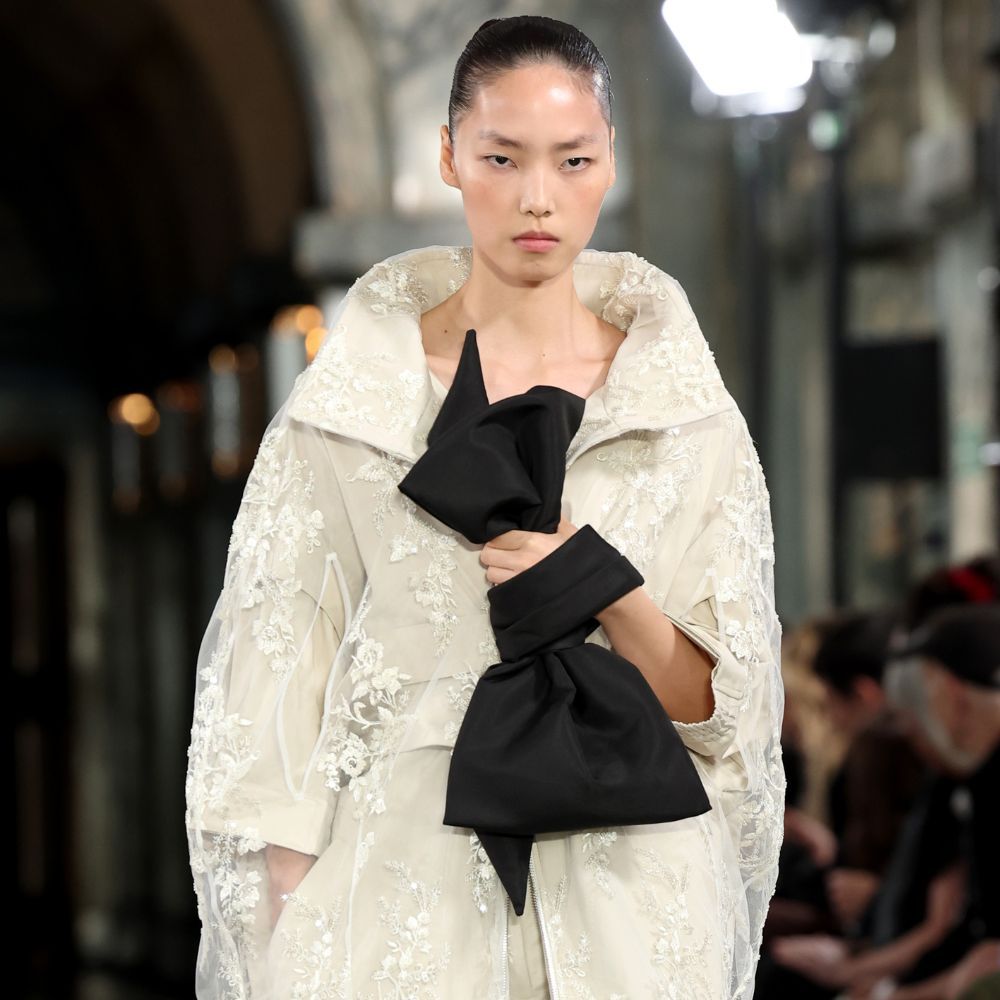
There is a particular kind of quiet that arrives when an artist stops performing emotion and starts carrying it. Simone Rocha's spring/summer 2027 collection, titled "I'm trying to love you," exists in that space. She has taken Caravaggio's *The Taking of Christ*, a painting defined by betrayal, shadow, and the brutal intimacy of capture, and translated it into something tender rather than tormented. That is the alchemy we look for: not the recreation of feeling, but the distillation of it. Rocha understands that romance is rarely loud. It is the hesitation before a touch, the weight of a glance held too long. Her work reminds us that devastation and elation are not opposites but partners, and she dresses them both with a poise that feels less like design and more like devotion.
For our readers who move through style as a form of self-connection, this collection is a lesson in emotional precision. It is easy to chase trends that shout, but Rocha's floral vision asks you to lean in, to notice the subtlety in the stitching, the deliberate imperfection in a petal. This is the same editorial eye we apply to our own coverage, where we find resonance in the understated. Consider how Elevated Footwear: Defining Fall's Quietly Stylish Sneaker Selection champions a similar restraint, or how Short nails, elevated style: Fall's manicure mood proves that chic rarely requires volume. Even in Lingerie as Layers: Daisy Edgar-Jones Redefines Modern Sensuality, we see the power of suggestion over declaration. Rocha operates on that same frequency; her clothes do not ask for attention, they command it through presence.
What strikes us most is the maturity of her approach to love. The collection does not romanticize pain, nor does it shy away from it. It holds both the agony and the ecstasy in the same hand, acknowledging that to create for love is to risk the mess of it. This is where Rocha's vision becomes a mirror for the modern muse. She is not interested in a fantasy devoid of friction. She wants the real thing, the kind of beauty that exists because of its flaws, not despite them. For the woman wearing this collection, the message is clear: you do not need to soften yourself to be feminine, nor harden yourself to be strong. You can be both, and it can be exquisite.
If you ask us what to take from this, it is this: pay attention to what does not scream. The most potent statements are often the ones whispered. Watch how Rocha layers her florals, how she plays with proportion and transparency, and consider how that same intentionality might appear in your own wardrobe. The concrete detail to watch is the construction of the flower itself, is it crisp or wilting, fresh or decaying? Because in Rocha's world, that distinction is not about the bloom. It is about the season of the heart she is dressing. And that is a sentiment worth holding onto, long after the final look has left the runway.