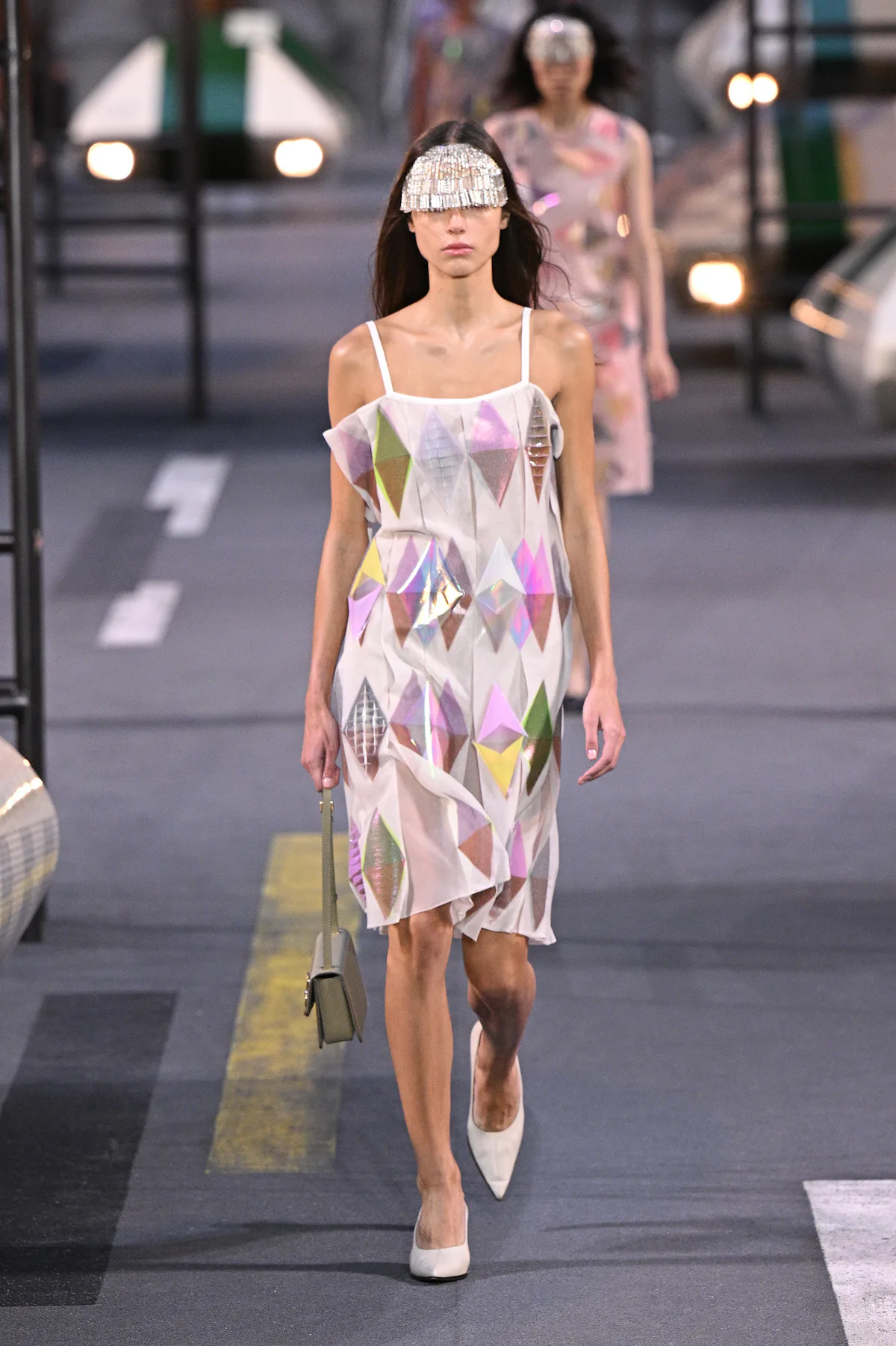
Nicolas Ghesquière has never been one to look backward for long, but with Louis Vuitton's Spring/Summer 2027 collection, he has charted a course that feels less like nostalgia and more like a deliberate departure. This is fashion as escape velocity. The show, staged in the Cour Carrée du Louvre with suspended vehicles painted in Damier stripes, was not merely a spectacle; it was a statement of intent. Where other houses cling to the familiar, Ghesquière asked us to consider what happens when classical architecture meets an imagined future. The result is a collection that feels both unsettling and serene, a contradiction we find ourselves drawn to. For the woman who has already mastered the art of quiet elegance, as explored in Zendaya's shortest silhouette yet, a study in quiet transformation, this collection offers a new vocabulary. It is not about rejecting the past but about carrying its weight into a new orbit.
The tension here is deliberate. Ghesquière layered Victorian dressing robes over space-age pantsuits, paired sleek black leather brogues with airy party dresses, and wrapped mustard yellow scarves around shapeless shift dresses covered in foliage-like embellishment. He is not choosing one era over another; he is collapsing time. This approach resonates because it mirrors the way we actually live now, pulling from different decades, moods, and identities to construct a self that feels true. The sheer organza midi dresses splattered with prismatic geometric patterns that seemed to activate with movement captured this energy best. They were not costumes for a future we cannot yet see; they were armor for the present, delicate and powerful at once. This is the same sensibility we admired in At Paris Fashion Week, the French girl trades denim for daring volume, where volume became a form of quiet rebellion. Here, the rebellion is quieter still, a bejeweled headpiece covering the top half of the face, a wired choker that reads as both restraint and liberation.
What makes this collection significant for our readers is not the spectacle of suspended cars or the shimmering procession of diamond-fringed models. It is the emotional register beneath the surface. The earthy, moss-like palette, disrupted only by limoncello outerwear and soft peach tops, suggests a grounding force. Even in the most futuristic silhouettes, there is a pull toward the organic, the tactile, the real. The oversized silk suiting that appeared to take flight mid-walk and the draped shift dresses covered in foliage-like embellishment evoke a world after something, after a party, after a storm, after the end of an era. This is not the shiny, sterile future of science fiction. It is a future that has learned to carry its ruins with grace. Ghesquière has always understood that luxury is not about escapism; it is about presence. And in this collection, presence means standing at the crossroads of what was and what could be, without flinching.
The takeaway is precise: pay attention to how Ghesquière uses restraint as a form of propulsion. The most powerful moments in this collection were not the loudest, they were the muted tones, the shapeless silhouettes, the transparent layers that revealed more than they concealed. For the woman who already knows that confidence does not need to announce itself, this is a masterclass in moving forward without leaving yourself behind. The question now is whether the industry will follow or cling to the familiar. We are watching.