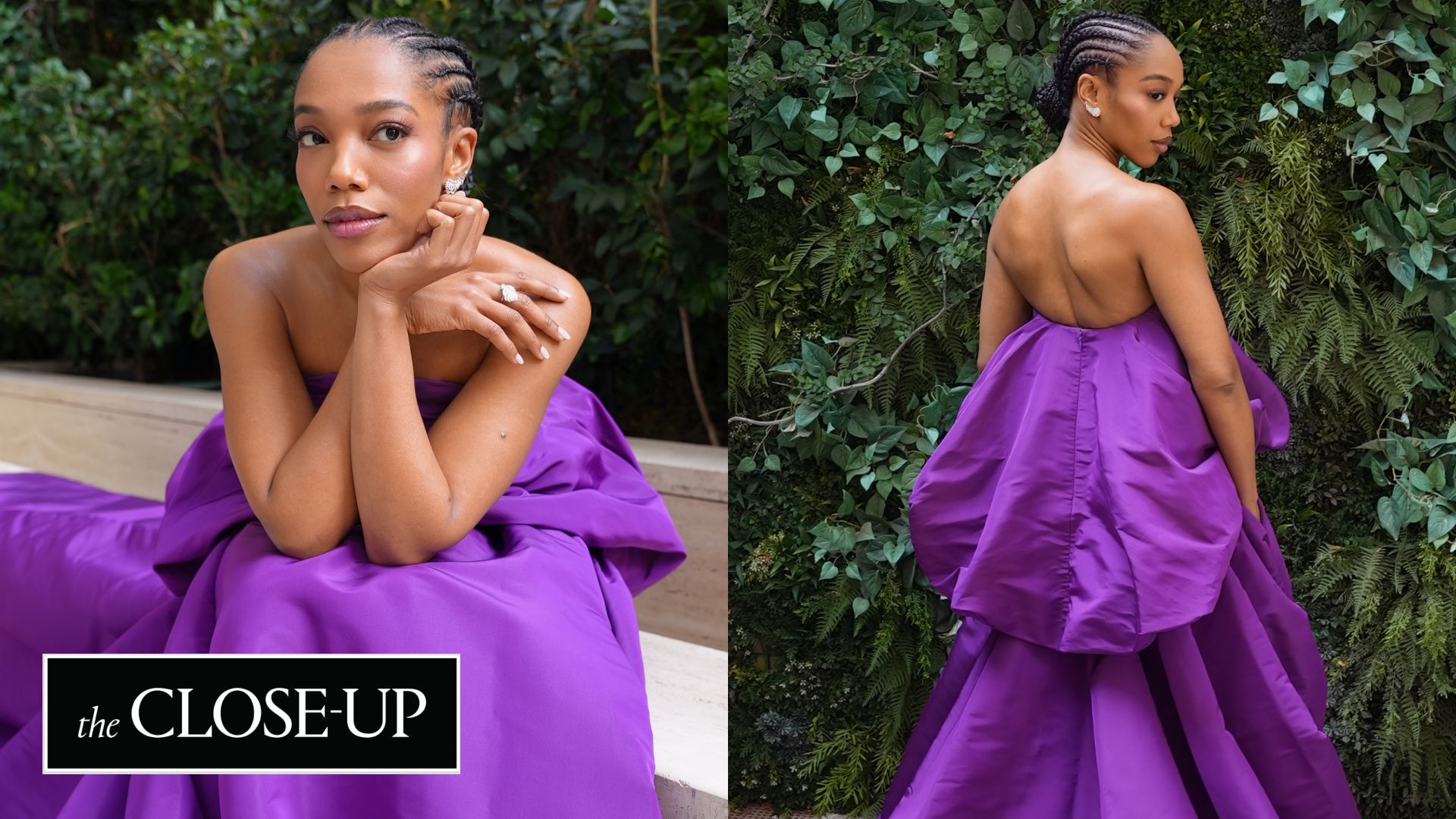
Naomi Ackie painted the Academy Museum Gala in a shade of purple that felt less like a statement and more like a quiet arrival. This was not a look that demanded applause; it was one that simply deserved it. In a sea of risk-taking silhouettes and anatomically-correct corsets, Ackie's custom Balenciaga ballgown, with its bubble-hem bodice and carpet-covering train, offered something rarer than shock value: emotional depth. It is the same kind of restrained, intentional power we have been observing in fashion's more thoughtful corners, from the quiet authority of the knee-length skirt at Prada to the broader conversation around dressing with intention rather than frustration. What Ackie understood, and what makes this moment worth noting, is that true confidence does not need to scream.
The British actor's approach to the evening was refreshingly self-contained. She did not frame the gala as a conquest or a career milestone, but as an environment to test a new color and a new silhouette. "When it comes to a really big fashion event, you can take risks and go big or go home," she said, yet her execution felt far from reckless. She grounded the drama of the purple ballgown in the things she already knows she loves: the clean lines of Balenciaga's tailoring, the comfort of cornrows, the ritual of a relaxing pre-red carpet routine. This is the difference between wearing a dress and inhabiting it. Ackie inhabited hers. She described the gown as a "real departure" from her usual column dresses, but she did not treat the departure as a reinvention of self. She treated it as an experiment in expression, which is precisely how the most compelling style evolves.
There is a lesson here in how Ackie prepared for the high stakes of the red carpet. She recently cleaned out her wardrobe, keeping only pieces she loves, and found that the edit made her braver. Simplifying her off-duty options made the big moments feel more approachable. It is a counterintuitive truth, and one we see echoed in the way the industry's most assured figures operate: Three models, one bra, an after-hours mood in black can often say more than a dozen competing elements. When Ackie says "the stakes are very low" and that the goal is merely to "show people a beautiful piece of art and then have a lovely time," she is not being modest. She is describing a mindset that allows for genuine risk. The pressure to perform evaporates when the intention is joy rather than approval.
The specific takeaway here is that Ackie's purple moment succeeded because she let the dress do its job without trying to outshine it. She chose a shade with depth, a silhouette with movement, and accessories that whispered rather than shouted. She skipped the necklace to let the Boucheron earrings and ring breathe. In an era where red carpet dressing can feel like a competition for the most complex narrative, Ackie offered something simpler: a woman who knows exactly who she is, wearing a dress that lets her be that person in a room full of people. The open question is whether more celebrities will follow her lead, not toward purple, but toward that same quiet, self-assured intentionality.