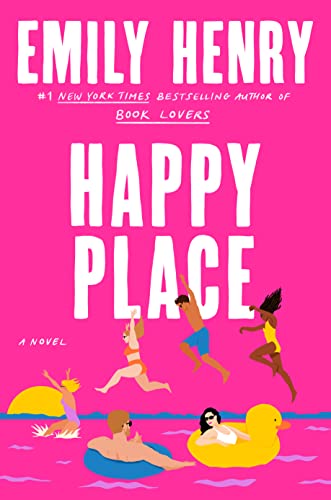
There is something quietly radical about trusting an author to write the screenplay for her own adaptation, and Netflix's decision to let Emily Henry pen the script for *Happy Place* feels like a rare act of faith in the source material itself. When so much of modern romance on screen is engineered by committee, tropes workshopped, edges sanded off, the choice to hand the story back to its creator suggests a belief that her voice is the draw, not a problem to be solved. For those of us who have long argued that a certain quiet elegance is worth preserving, this is the editorial equivalent of letting the fabric dictate the cut.
The novel's premise, a recently broken-up couple pretending to be together for a final group holiday in Maine, works because it never mistakes nostalgia for resolution. Harriet and Wyn are not waiting for a grand gesture; they are waiting for themselves to catch up to what they already know. That interiority is precisely what gets lost when a story is flattened into a series of meet-cutes and rain-soaked confessions. Henry writing her own script does not guarantee fidelity, but it does signal that the emotional texture of the book, the slow unfurling of why two people who love each other cannot stay together, will be treated as the plot, not an obstacle to it. In a season where the bold coat shift is redefining how we think about winter luxury, this adaptation is choosing restraint over spectacle, and that is a far more interesting risk.
The behind-the-scenes involvement of Jennifer Lopez's Nuyorican Productions adds another layer worth watching. Lopez has built a career on second acts, on the specific charisma of someone who knows exactly what she wants and has learned how to ask for it without apology. That energy aligns neatly with Harriet's arc, and it suggests the film may resist the temptation to soften its heroine into likability. What remains to be seen is whether the casting will match the interiority of the writing. Eve Hewson, whom Henry has publicly suggested for Harriet, carries a stillness that reads as intelligence rather than passivity, an essential quality for a character whose conflict is largely internal. The right casting will not just look like the book; it will feel like it.
The practical takeaway for readers is this: pay attention to who writes the script, not just who directs or stars. *Happy Place* is being treated as a feature film rather than a series, which compresses the timeline and forces the story to earn its emotional beats without the luxury of eight hours of preamble. That compression, in the hands of the person who invented the characters, could produce something tighter and more honest than any committee-driven expansion. The culotte finds its quiet place in a wardrobe not by shouting for attention, but by proving it belongs. Henry's screenplay is that kind of choice, unflashy, deliberate, and worth waiting for.