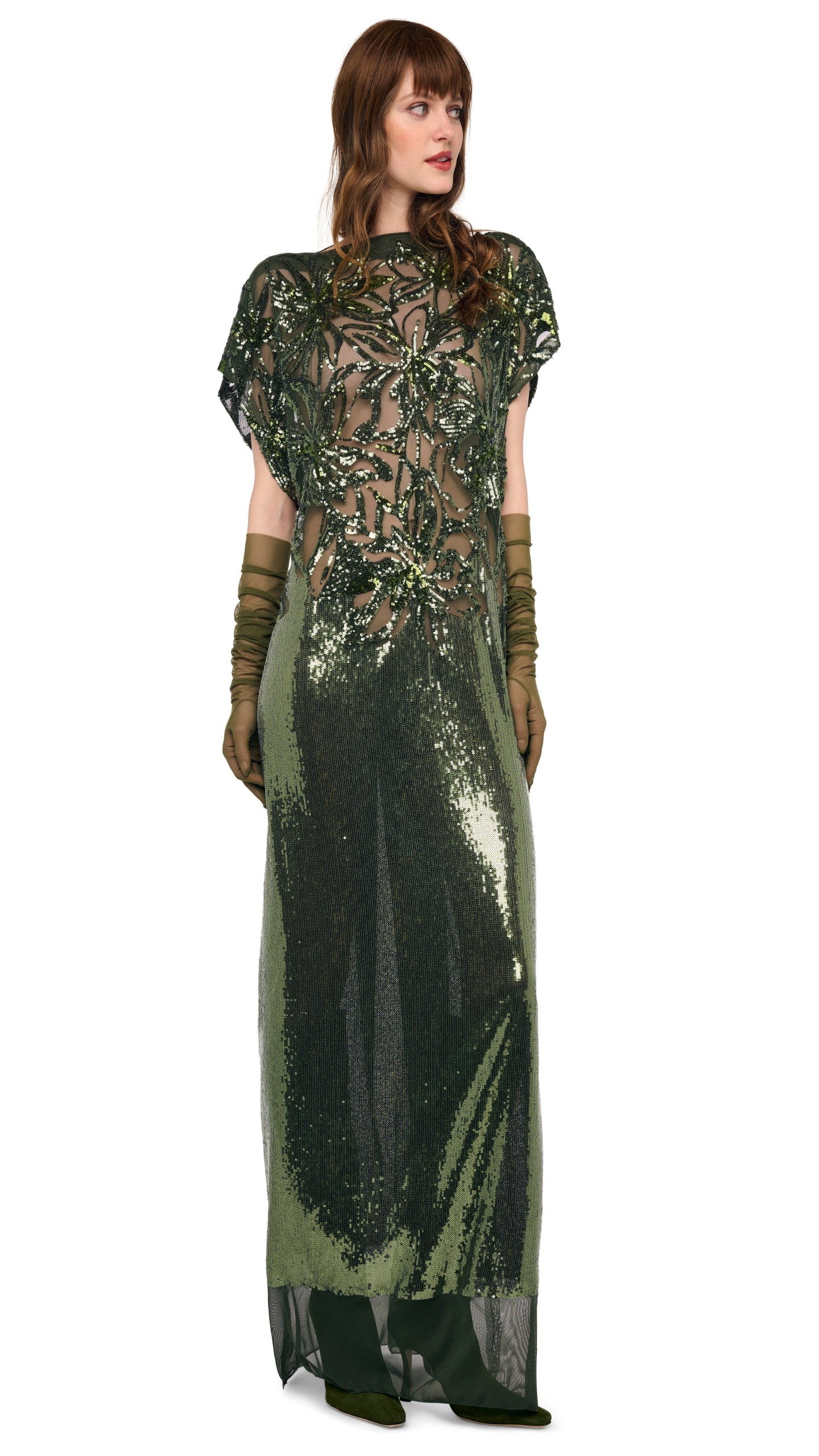
There is something quietly radical about a woman who plans her wedding the way Jennifer Atilémile plans a party: with colour charts instead of commands, with joy as the only non-negotiable, and with the confidence to say "go extra or go home" as though it were the most natural thing in the world. Her approach to Old Hollywood glamour, refracted through a midsize lens and a holiday-season calendar, feels less like a dress code and more like an invitation to reclaim pleasure in dressing. This is not about spectacle for its own sake. It is about the permission to be expressive when the world feels heavy, and that makes her perspective worth sitting with.
Atilémile's wedding dress code, formal cocktail, jewel tones, no white, no bridal, is a masterclass in intentional hospitality. She did not dictate; she curated. The colour palette she chose (burgundy, chartreuse, emerald, ruby, that particular Yves Klein blue) works because it is both opulent and repeatable. These are not one-night-only shades. They are the kind of tones that migrate from a December wedding into a January dinner or a February evening, which is precisely the point. She understands, as we explored in The Year Fashion Found Its Quiet Confidence, According to an Expert, that true style is not about a single moment but about the quiet continuity of taste. The same sensibility that made her reach for Dôen's beaded dresses and Rixo's embroidered jackets also led her to Etsy and Poshmark for vintage velvet and one-of-one opera coats. Old Hollywood glamour, in her hands, is not a costume. It is a mood made modern through practicality: velvet dusters found secondhand, sequined gloves bought on a whim, feathered mules from Jeffrey Campbell worn with something already in your closet.
What makes this perspective so compelling is the way it sidesteps the usual tension between maximalism and restraint. Atilémile is not advocating for a return to excess in the old sense. She is advocating for a return to play. The "go extra or go home" directive is not about spending more; it is about showing up more. That is why her advice to trawl Depop and eBay for hidden gems feels so aligned with the measured indulgence we admired in Quiet luxury meets measured indulgence at Banana Republic. Both approaches value intention over volume. Both understand that a single extraordinary piece, a lime-green chinoiserie opera coat, a vintage Persian boteh robe, a pair of 1990s Manolos with ostrich feathers, carries more weight than a rack of forgettable options. The difference is that Atilémile invites us to hunt for that piece ourselves, to make the search part of the joy.
The most telling detail in her story is not the dress code or the colour palette. It is the way she describes the season itself: "cold, cozy, and warm all at once." That is the emotional texture she is asking her guests, and, by extension, her readers, to carry into their own holiday dressing. She is not selling a look. She is offering a permission slip to be present, to be playful, and to trust that a well-chosen jewel tone or a feathered hem is not frivolous but necessary. The question her story leaves open is whether we will take that permission. The holiday parties will come, the invitations will arrive, and the temptation to default to black will remain. But if we follow her lead, we might find ourselves reaching for chartreuse instead.