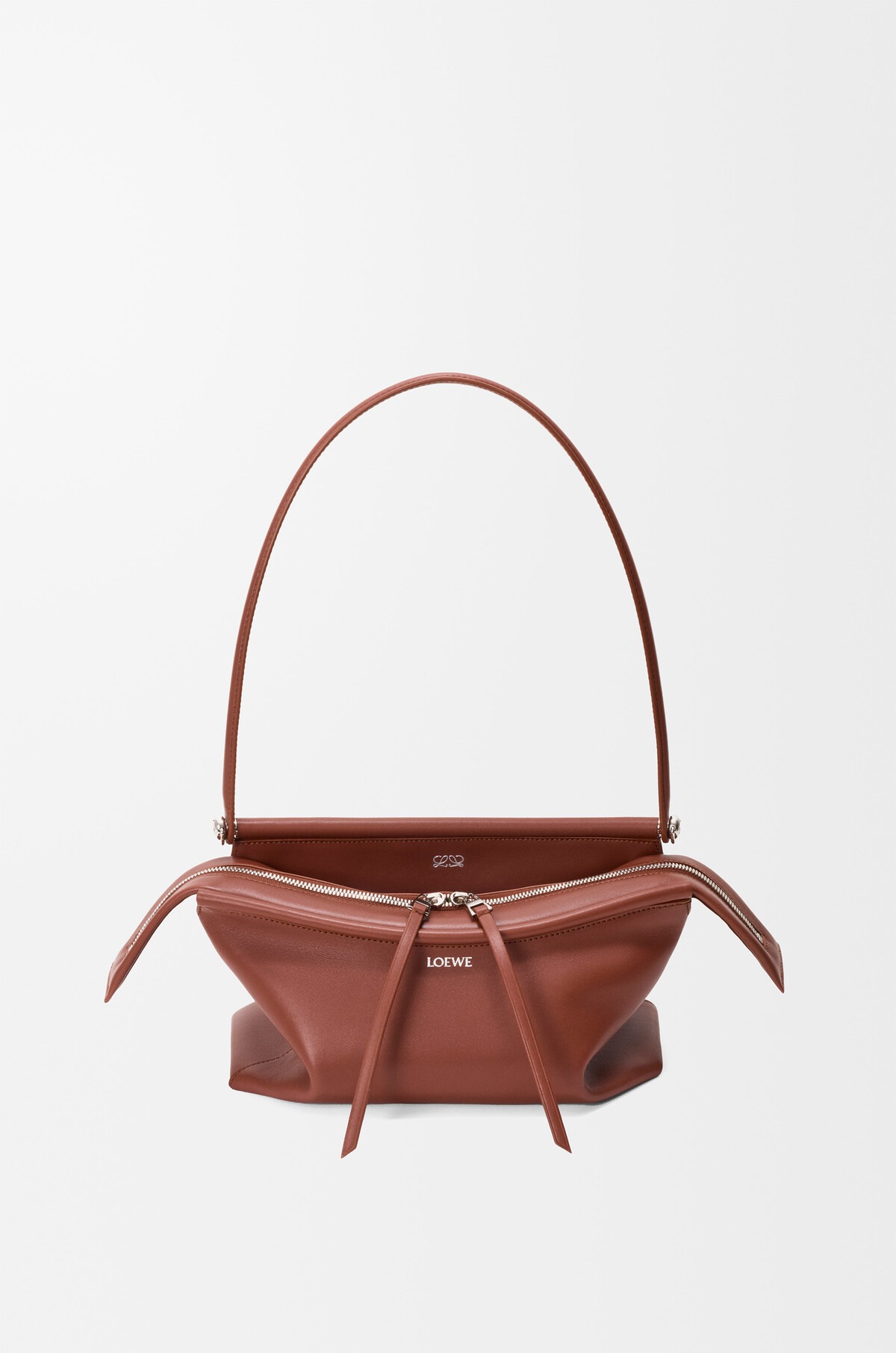
There is something quietly magnetic about a bag that does not need to announce itself, and Loewe's Whisker has that quality in spades. Jack McCollough and Lazaro Hernandez have been at the house for less than a year, yet their fall/winter 2026 introduction already feels like a natural extension of the brand's visual language, playful without being childish, sculptural without being stiff. In a landscape where quiet luxury often means erasing personality, this bag insists on having one. It fits neatly alongside what we observed in The refined detail that signals quiet style without a word: the most compelling accessories today communicate through gesture, not volume.
The Whisker's name is literal and earned. Those zipper pulls and side tassels genuinely evoke a cat's whiskers and ears, but the trick is that the reference never feels gimmicky. It lands because the execution is precise. Soft glazed leather and structured folds give the silhouette a supple collapse against the body, while the longer structured handle sits comfortably on the shoulder even over a winter coat. The round button hardware on the strap allows movement rather than resistance. These are details that reward close looking, and they reflect a design ethos that we have traced before in Decoding Loewe's Quiet Signals for 2027: the brand has long understood that restraint and wit can coexist. Where the Amazona 180 was a reinvention of an archive piece, the Whisker is entirely new, and that confidence in original design is worth noting.
What makes this bag resonate beyond the runway is how naturally it adapts to different personalities. Petra Collins wore it on the shoulder with a pencil skirt and fitted blazer, polished, deliberate. Hannah Einbinder tucked it under the arm as a clutch with jeans and a leather jacket, relaxed, unstudied. Both looks work because the bag does not impose a single mood. The color range reinforces this versatility: butter yellow, cherry red, black plaid, light-brown plaid. None of them feel like a statement for its own sake. This is the kind of accessory that lets the wearer define the context, not the other way around. It recalls the observation in The bag your most polished friend already bought for autumn that the best purchases are polished without feeling too precious.
The specific takeaway here is not that the Whisker will become another It bag, that much is already evident from the speed of its adoption. The more telling detail is what it signals about McCollough and Hernandez's direction for Loewe: they are not leaning on nostalgia or heritage to generate desire. They are trusting that a fresh idea, executed with restraint and a touch of humor, can earn its place in a crowded market. The question worth watching is whether this approach will define the house's accessories going forward, or whether the Whisker remains a charming outlier. Either way, it has already proven that quiet luxury does not have to be quiet about everything.