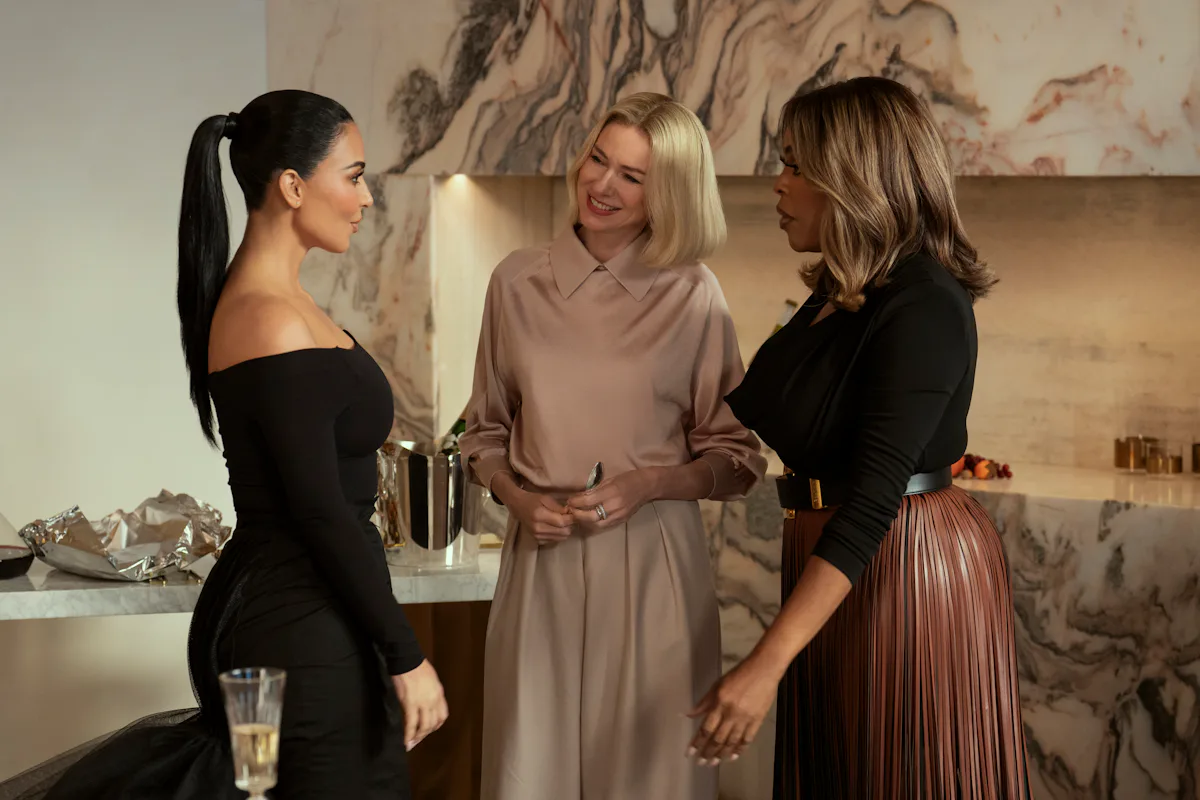
Costume designer Paula Bradley's work on *All's Fair* Season 2 is not just a wardrobe update; it is a masterclass in how clothing builds narrative without a single line of dialogue. We admire the editorial restraint, the way a velvet hooded cape can signal a character's arrival before she speaks, or how a shift from soft neutrals to darker territory tells us a woman has found her nerve. In an era of visual noise, this kind of intentional dressing feels like a quiet power move. For our readers, the takeaway is practical: a wardrobe that evolves with a character's inner world is never accidental. It is the result of a designer who treats every seam like a sentence.
Consider the Scorpio Ball scene, where Kim Kardashian's Allura wears the actual Tiziana Roma cape Elizabeth Taylor wore to Grace Kelly's 1969 party. The detail is not mere spectacle, it is a deliberate nod to lineage and legacy, a theme we explored in The Zodiac Archetypes Driving the Power Plays of All's Fair. Bradley had to photograph and measure the original, then commission hand-assembled copies that mimic half a century of aging. That level of craftsmanship, applied to a television schedule, elevates the show's visual language from costume to couture. Meanwhile, Sarah Paulson's Carr gets sharper shoulders and a highlighter-yellow Balenciaga cocoon coat, a deliberate jolt of color in a character who typically lives in black and cream. These are not random choices; they are signals, and Bradley trusts her audience to read them.
What interests us most is the emotional intelligence behind the dressing. Naomi Watts' Liberty moves from pale neutrals into bolder territory, and Bradley says she "gets her balls" this season, a character arc rendered in Valentino and darker silhouettes. Niecy Nash-Betts' Emerald loses her trademark hats due to lighting constraints, and the solution is not a compromise but a new signature: statement belts sourced from across Europe. The problem-solving here is elegant, a reminder that constraints often yield the most creative results. Even the actors participate in the hunt, with Sarah Paulson sending voice messages from around the world and Niecy Nash-Betts arriving to set "themed out" in cowboy hats and chaps. The wardrobe becomes a dialogue between designer and performer, not a dictation.
The most satisfying detail, however, is the on-set reaction. The actors do not see each other's looks until they arrive for a scene, and they spend the first moments exchanging compliments. Bradley calls them all her children, and she wants them to feel like rock stars. That generosity of spirit, the desire for every woman to feel amazing, is the quiet philosophy behind every beaded thread and borrowed brooch. As we noted in The Quietly Elegant Coat I Choose Over a Puffer Jacket, the most memorable style choices are often the ones that feel personal rather than performative. In *All's Fair*, the clothes do not just serve the plot; they serve the women wearing them. The open question for Season 2 is whether Carr's plan to take down the firm will be matched by an even sharper silhouette, and whether Liberty's newfound bravery will outlast the finale.