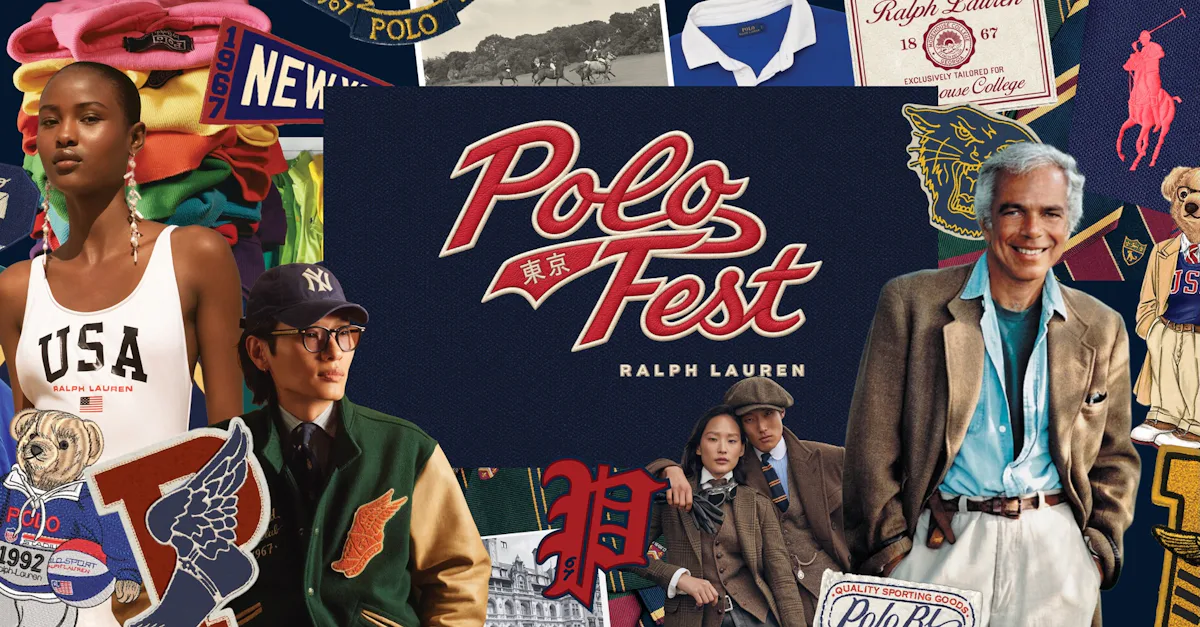
There is something quietly profound about a brand that chooses Tokyo to celebrate sixty years of American craft. Ralph Lauren's PoloFest, a three-day immersive gathering in the Jing Harajuku district, is not merely a milestone event, it is a quiet acknowledgment that the most enduring legacies are built on cultural exchange, not spectacle. For those of us who understand that style is a language spoken in quiet details, this celebration feels less like a party and more like a quiet homecoming. And if you have been following the season's quiet shifts, from the unexpected return of a cummerband to the quiet depth of a plum-toned autumn, you already know that Ralph Lauren's magic has never been about noise. It has always been about the weight of a well-worn leather jacket, the crispness of a collar, and the quiet confidence of a silhouette that knows exactly where it belongs.
The choice of Tokyo is not incidental. Polo arrived in Japan in 1976, and the city has since become a quiet epicenter of the brand's most devoted collectors, those who hunt for archival pieces with the same reverence that a collector holds for a first-edition novel. Polo Fest, hosted in the Jing Harajuku district, honors that devotion by curating a space where vintage dealers, writers, designers, and stylists gather not to sell, but to share. It is a deliberate act of curation that mirrors the very ethos of the brand: craftsmanship is not a transaction, it is a conversation. And in a world where fashion often screams for attention, Ralph Lauren's quiet gesture, an immersive, customized space built for conversation, feels like a quiet rebellion. It is the kind of gathering that reminds us why the skirt that replaced your pants feels so right this season: because quiet confidence never needs to announce itself.
What makes this moment worth watching is not the spectacle of a 60th anniversary, but the quiet truth it reveals about the brand's enduring relevance. Ralph Lauren's Spring/Summer 2025 collection, shown at New York Fashion Week, was a masterclass in romantic restraint: leather jackets that feel lived-in, blazers that sit with intention, and worn-in denim that carries the weight of memory. That collection was not a declaration; it was a quiet reflection of the same ethos that brought Polo to Tokyo decades ago. The brand understands that true luxury is not about the new, it is about the familiar, worn beautifully. And for those of us who have long understood that quiet luxury is not a trend but a way of being, this moment offers a quiet invitation: to sit with the history, to honor the craft, and to ask ourselves what it means to build a legacy that whispers louder than any shout.
The question that lingers, then, is not whether Ralph Lauren will survive another sixty years. It is whether the industry will remember that the most powerful statements are the ones that never need to be spoken aloud. For those who attend PoloFest, the real takeaway is not a limited-edition piece or a panel discussion, it is the quiet reminder that the most enduring brands are built not on spectacle, but on the quiet trust of a community that knows quality when it feels it. And that, perhaps, is the most beautiful legacy of all.