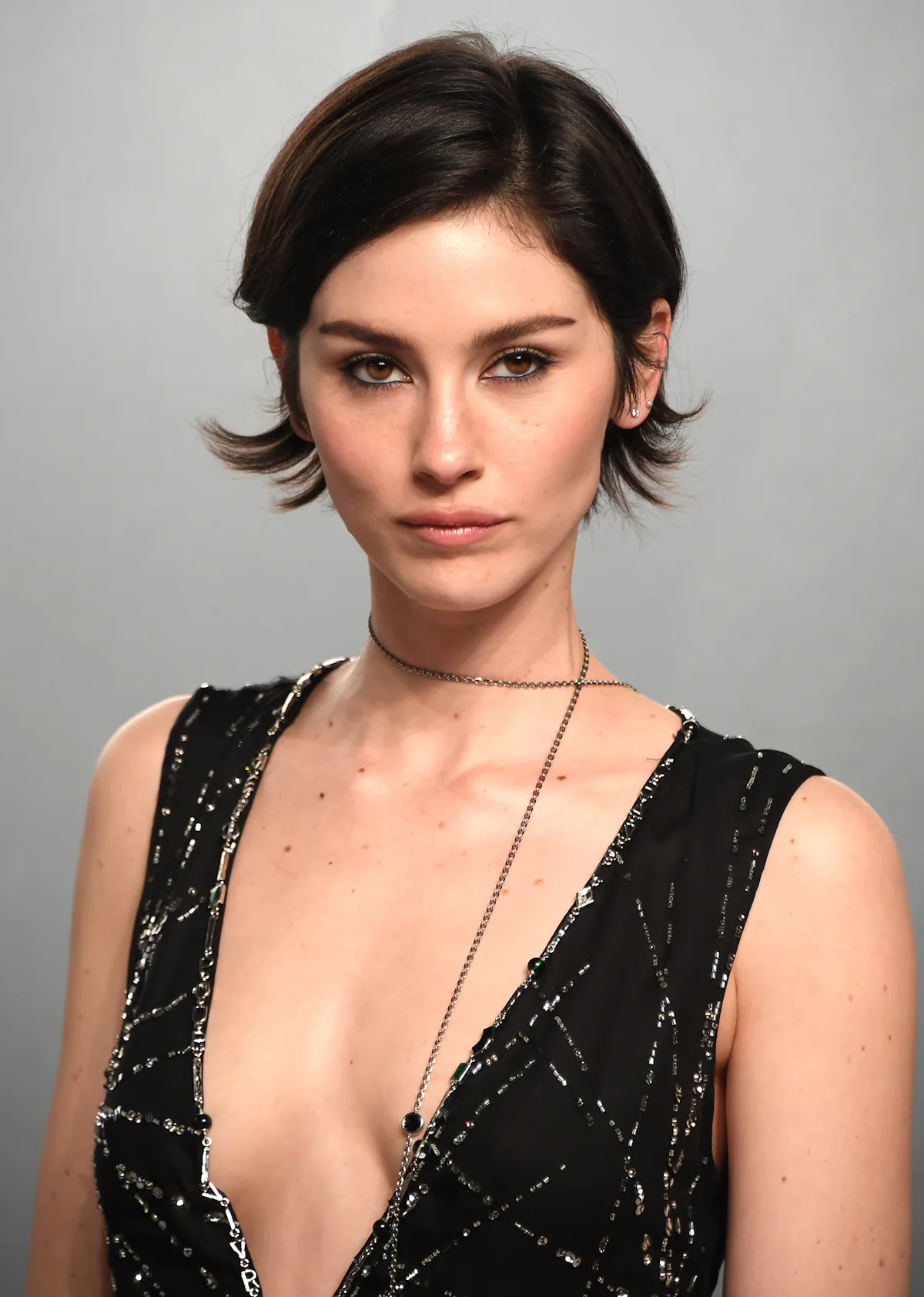
Some trends return with a roar; the flippy bob returns with a quiet, knowing flick. It is a style that has cycled through decades, from Marlo Thomas in the late sixties to the Olsen twins in the nineties, but its latest incarnation feels distinctly of this moment: sleek, minimal, and impossibly intentional. What we find compelling is not the sheer volume of celebrities wearing it, from Kim Kardashian to Ayo Edebiri, but the restraint with which they are wearing it. This is not the bouncy, high-volume flip of the past. It is a subtle gesture, a faint turn at the ends that suggests confidence without effort. The trend mirrors something we have been watching in fashion all season: the quiet appeal of the It-Girl sneaker that still waits, a piece that refuses to shout for attention. Like that sneaker, the flippy bob works because it feels personal, not prescribed.
For our reader, this is not about copying a celebrity haircut. It is about understanding the mood behind the choice. A bob has always signaled a kind of self-possession, a willingness to edit, to remove, to trust that less is more. What the current iteration adds is a softness that feels modern. Margot Robbie's subtle flip with a deep side part balances vintage glamour with the ease of a French bob; Léa Seydoux's center-parted version proves elegance does not require asymmetry. Even the wet-look interpretations worn by Selena Gomez and Kim Kardashian to the same gala feel less about trend-chasing and more about personal punctuation. The flippy bob is not a uniform. It is a canvas. And as the winter mini skirt turns a hoodie into eveningwear, we see the same principle at play: the most refined looks often come from playing with proportion and texture rather than accumulating more.
What makes this resurgence worth paying attention to is the diversity of its ambassadors. The style has been claimed by Carey Mulligan, who wears it with a tousled, almost undone texture, and by Gracie Abrams, who favors the faintest flick at chin length. It appears on Lupita Ny'ong'o, who has shown the cut's versatility by styling her sisterlocs into everything from perky ponytails to center-parted flips, and on Hailee Steinfeld, who moves between sleek and bouncy versions with equal ease. This is not a single look but a language. The bob adapts to the woman, not the other way around. It can feel polished for a Chanel dinner, as America Ferrera proved, or effortlessly cool for a night out, as Hannah Einbinder demonstrates. The through line is not the shape of the hair but the sense of self it projects.
The practical takeaway is this: the flippy bob rewards those who understand their own texture and temperament. It is not a style that hides. It sits at the jawline, framing the face, demanding that you meet it with presence. Before you book the appointment, ask yourself what you want the cut to say. The celebrities wearing it best, Emma Stone at the Golden Globes, Gigi Hadid after Chris McMillan's scissors, are not hiding behind volume or distraction. They are showing up as themselves. That is the real trend, and it is one worth following.