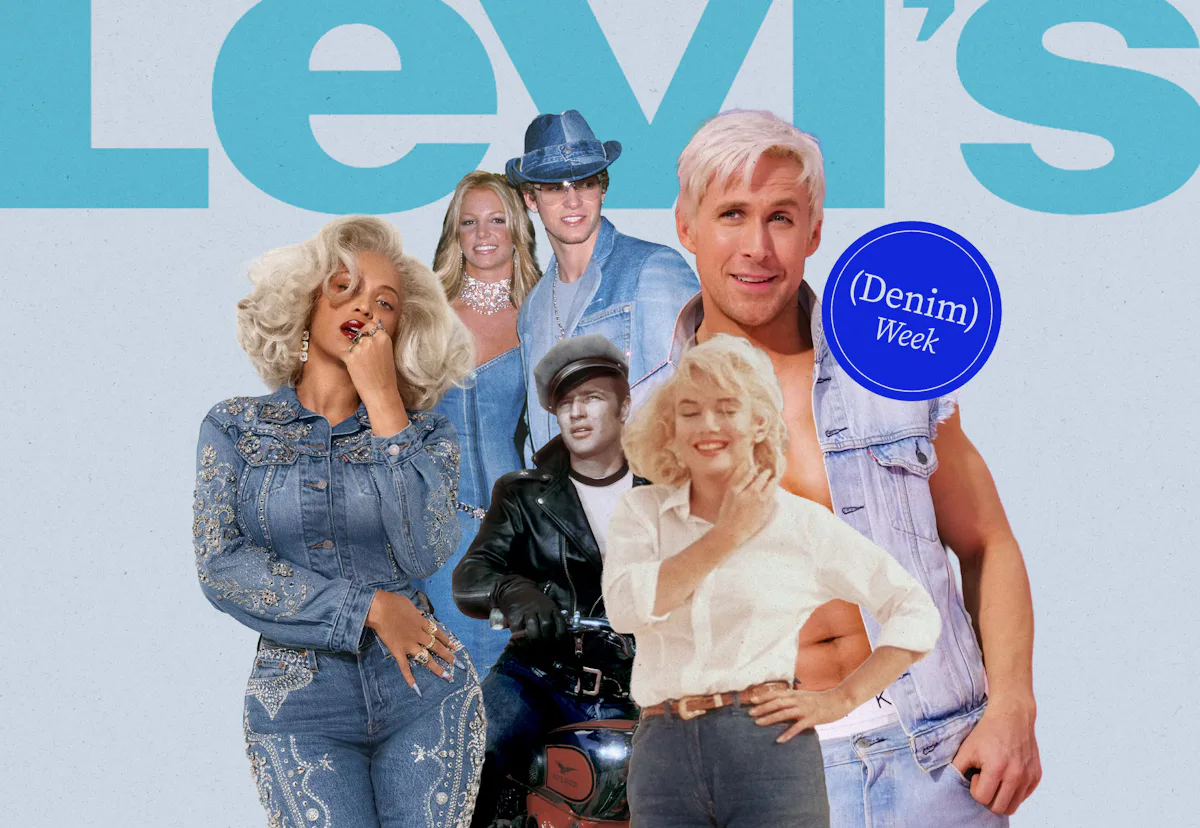
There is something deeply moving about a garment that has been worn by miners and movie stars, rebels and rodeo riders, and still feels like it belongs to you the moment you pull it on. Levi's has achieved what few brands ever do: it has become a cultural archetype rather than a mere product, a quiet through-line connecting John Wayne's cowboy, Marlon Brando's biker, and the four best friends in *The Sisterhood of the Traveling Pants*. For our Nineteen layers for the season I've been waiting to wear, we celebrated the ritual of dressing with intention, and Levi's represents that same idea on a grander scale: a single pair of jeans that carries the weight of 150 years of American mythology, yet remains utterly personal.
The magic of Levi's is its ability to absorb meaning without ever declaring it. Costume designer Janie Bryant, who dressed the *Yellowstone* prequels, noted that the same pair of 501s can feel hardworking, rebellious, polished, or completely relaxed depending on how it is worn. That restraint is precisely what elevates denim from necessity to icon. When Marlon Brando strutted through *The Wild One* in his leather jacket and 501s, he transformed workwear into rebellion not by altering the jeans but by altering the context. When Marilyn Monroe cinched her Lady Levi's 701s in *The Misfits*, she made the same rugged fabric look glamorous through nothing more than how she moved. This is not a brand that shouts for attention; it is a brand that waits to be inhabited, and that quiet confidence is why it has endured while so many others have faded.
We often talk about luxury as something that must be rare or inaccessible, but Levi's proves that true cultural power lies in the opposite direction. Anyone can buy the same 501s Brando wore, and when you put them on, you inherit a fragment of the myth along with the denim. Celebrity stylist Mark Avery described how his own working-class upbringing was reframed by *The Outsiders*: ripped-up 501s became a flag of rebellion rather than a sign of limitation. That transformation, from economic necessity to chosen identity, is rare and precious. It is the same self-possessed energy we admired in Kristen Bell Turns a Preppy Classic Into a Study in Effortless Romance, where a classic piece becomes a canvas for personal expression rather than a uniform.
The single detail worth watching is how Levi's continues to evolve without losing its anchor. The brand has survived the shift from cowboy to greaser to hippie to minimalist, and now finds itself in a moment where authenticity is the ultimate luxury. Stylist Tiffany Briseno pointed out that the Western heritage Levi's draws from is rooted in Mexican vaquero tradition, not Hollywood fantasy, and that grounding matters more as consumers become more discerning. The quiet cultural weight of a pair of Levi's is not that it represents one story, but that it holds space for all of them, and that is a kind of luxury no price tag can replicate.