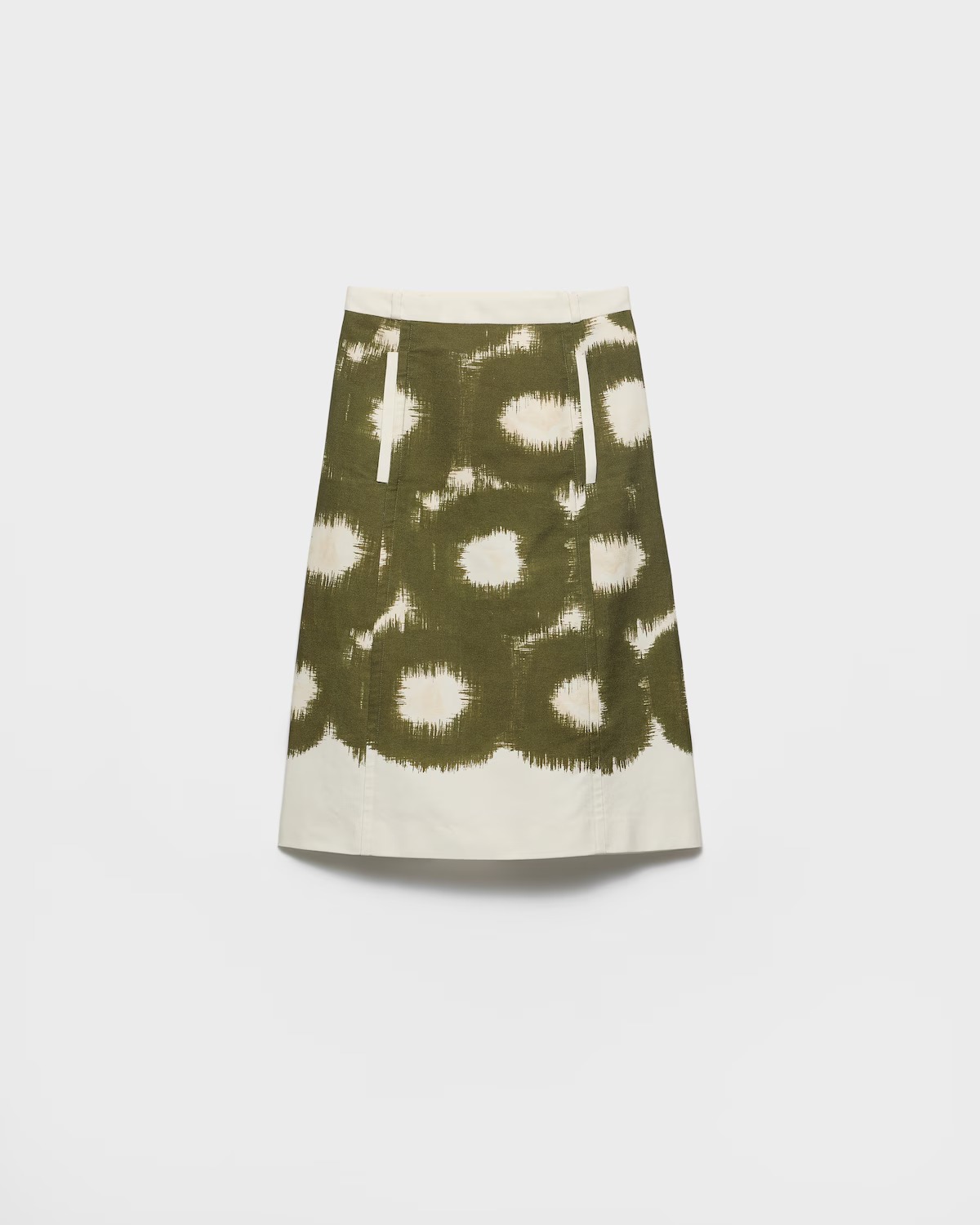
The skirt is not coming back. It never left, and it was never merely an item of clothing. It is the quiet centerpiece of a wardrobe that has finally stopped performing, and Prada's spring/summer 2027 show, titled *The Skirt*, only confirms what we have been feeling for some time: the most radical thing a woman can wear is a garment that asks for nothing but her presence. Miuccia Prada and Raf Simons call it "an interrogation of this single, universal garment, through protean variation," and we agree, though we would add that the interrogation was never about the hemline. It is about what we expect from dressing at all.
For our readers, this is not a trend report; it is a permission slip. The show's range of shapes, proportions, and materials points to a truth we have long championed: that style is an inner state, not an external achievement. The skirt, in its many protean forms, becomes a mirror for how we want to move through the world, with soft confidence rather than aggressive assertion. This is why we connect the collection to From Parisian ateliers to desert light, a woman of quiet worlds, where a woman's wardrobe is a study in atmosphere rather than statement. And it is why we contrast it with Quiet Alternatives to Heavy Boots, From Adidas to Puma, where the focus is on ease underfoot. The skirt, unlike the boot, does not ground you; it frees you. It does not demand attention; it rewards attention given slowly, deliberately.
The practical consequence of this shift is that we must relearn how to shop. Not for the piece that shouts, but for the piece that hums. The skirt, as Prada and Simons present it, is not a trend cycle item; it is a long-term relationship. It asks us to consider proportion over pattern, drape over detail, and intention over volume. This is where the emotional weight lives. A skirt that moves with you, that catches light without trying, that feels like a second skin, is not a purchase. It is a commitment to a quieter kind of self-expression. And that is precisely why we are not surprised that the article frames this as the garment recalibrating the wardrobe. It recalibrates the woman too, if she lets it.
The detail to watch is not the length or the fabric, but the way the skirt changes the rest of the look. When the bottom half is the focus, the top half must learn to whisper. That is a discipline most of us have not practiced. So our takeaway is simple: before you buy anything, ask if it can hold a room without raising its voice. If the answer is yes, you have found your centerpiece. If not, it is just another piece of clothing, waiting for a moment that will never come. The skirt's return is not about fashion. It is about the quiet power of choosing what you wear to feel more like yourself, not less.