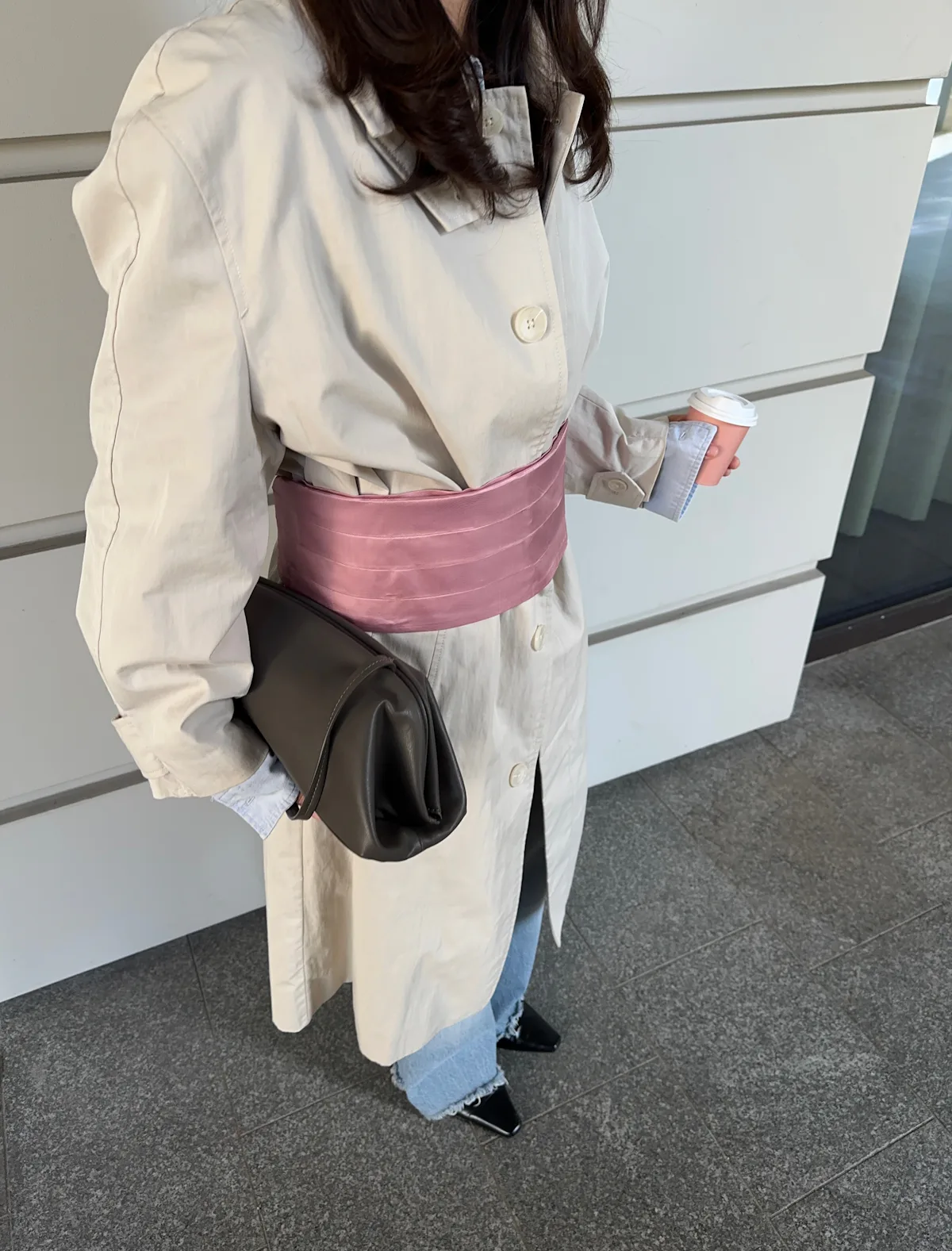
There is something quietly radical about a cummerbund crossing over into a woman's wardrobe, and it has nothing to do with borrowing from menswear. This season's unexpected trend is not a playful nod to tailoring; it is a quiet reclamation of structure itself. The cummerbund, long confined to black-tie formality, now appears on runways at Kallmeyer, TWP, and Valentino as a deliberate tool for shaping silhouette and intention. And that, we believe, is precisely why it belongs in your rotation. If you have already explored how The Quiet Code That Defines Your Style Archetype shapes your instinct for structure, this accessory becomes less a novelty and more a natural extension of your own visual language.
What makes the cummerbund compelling is not its novelty but its restraint. Where a belt cinches, a cummerband wraps, offering a softer line of definition that does not compete with the fabric beneath. At Kallmeyer, white cummerbunds layered over cream silk and cobalt blue pleats created a dialogue between softness and structure that felt intentional rather than theatrical. At TWP, the same piece in black disappeared into matching trousers, offering a subtle interruption of silhouette rather than a declaration. This is not a trend that demands attention; it is one that rewards those who already understand the value of a restrained silhouette. For anyone who has considered the quiet return of the boot this season, the same principle applies: the most impactful details are often the ones that do not shout.
Practically, the cummerbund asks you to reconsider where you place your focus. A colorful iteration, such as the rich purple offset against neutral tailoring, breaks a monochrome look without shouting. A printed version, paired with striped trousers and a ruffled blouse, introduces texture without chaos. And for those who prefer a more everyday approach, the layered denim jacket over a striped polo and pastel cummerboard, as demonstrated by writer Jalil Jackson, proves that this piece is not reserved for evening. The key is to let the cummerbund do the work. Keep jewelry minimal, let the fabric speak, and trust that a single gesture of structure can carry an entire look.
What remains most interesting about this moment is not how many ways exist to style a cummerbund, but what its presence signals about our relationship with clothing. The cummerbund does not offer convenience. It requires a pause, a decision, a moment of intention. That is its quiet power. As you consider whether to introduce this shape into your wardrobe, ask yourself not whether it suits your silhouette, but whether it aligns with the way you wish to move through the world. The answer, we suspect, will be quieter than you expect.