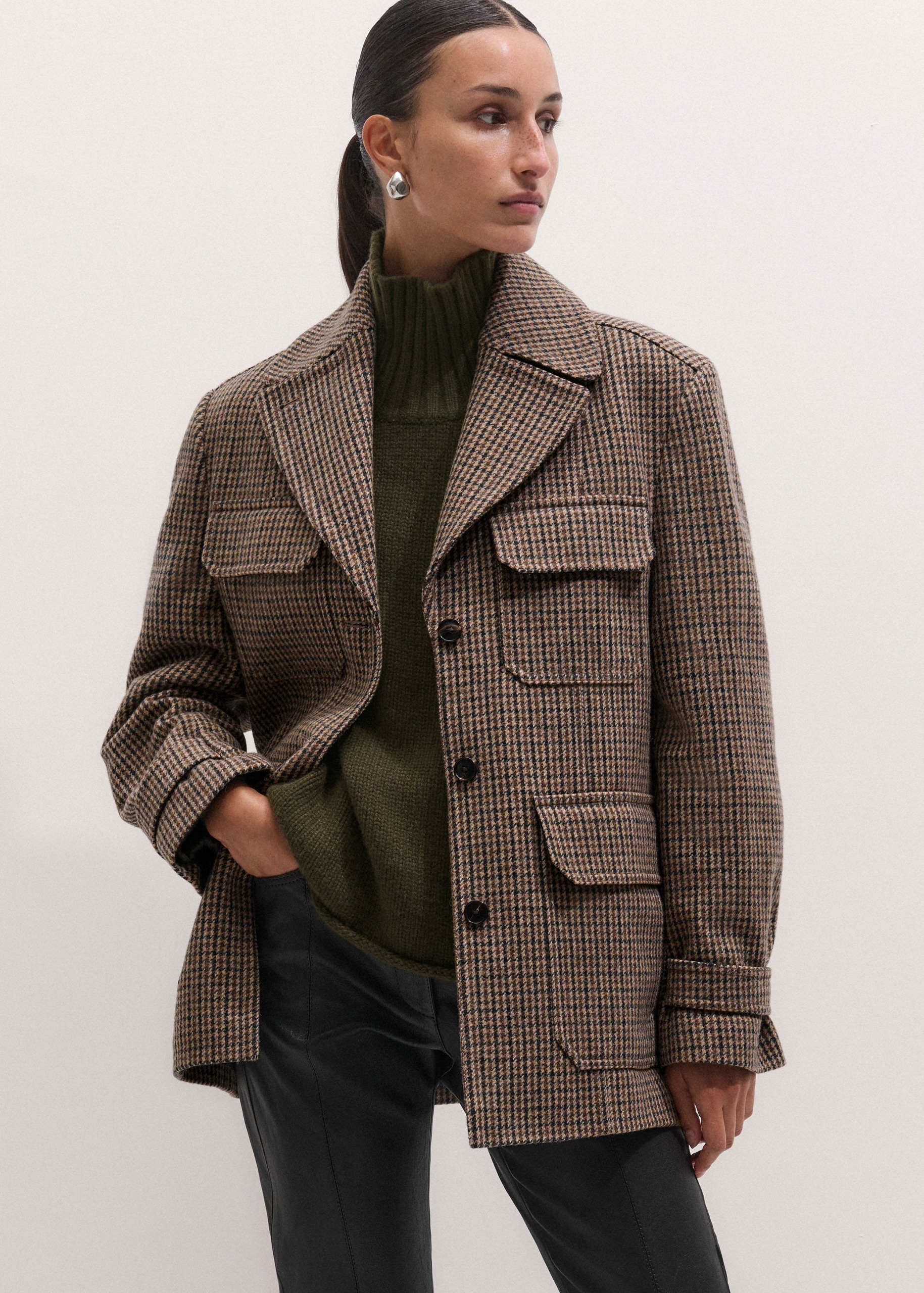
There is something quietly magnetic about a woman who borrows from a city she has never lived in and makes the look entirely her own. Monica Barbaro did not need a British postcode to channel the effortless cool of London's winter streets; she needed a single jacket. The pub jacket, as worn by Barbaro at the London Film Festival and sourced by stylist Elizabeth Saltzman from ME+EM, is not a costume piece. It is an invitation. And we find ourselves asking why we ever thought we needed permission to dress like a local before setting foot on the soil. The instinct to wait until we have earned a place, a honeymoon in the Cotswolds, a Fashion Week invitation, before we allow ourselves to inhabit its aesthetic is a small but persistent form of self-denial. Barbaro, a Californian, did not wait. Neither should you.
What makes this outerwear moment worth examining is not the jacket itself, though the ME+EM version in wool-blend houndstooth with its boxy cut and blazer-like lapels is undeniably refined. What matters is the quiet permission it grants. The pub jacket works because it asks nothing of you except presence. It is structured enough to hold its own shape, relaxed enough to let you move through a cold afternoon without clutching a sweater beneath it. When a London friend simply said, "Hi, neighbour," the approval was not about geography. It was about belonging to a feeling. That same sense of ease surfaced in a conversation we followed recently about Prince Harry reflecting on his children's quiet ease in Britain, the way comfort in a place can be felt before it is fully understood. The pub jacket offers that kind of quiet. It is not trying to prove anything.
We watched the street style from London Fashion Week closely, and the pattern was unmistakable. Multi-pocket jackets in similar silhouettes appeared again and again, not as trend pieces but as foundational layers. The Barbour version spotted in September carried the same barn-jacket ancestry, the same relaxed authority. What the pub jacket does so well is bridge the gap between practicality and polish without sacrificing either. The Levi's alternative, with its quilted lining and relaxed lapels, proved that the look does not require a British label. It requires intention. A white T-shirt, straight-leg jeans, a leather belt, the formula is almost disarmingly simple. And yet it produces a shift. The woman who wears it begins to move differently. She is not performing London; she is performing her own sense of self, and the jacket simply holds the space.
The most telling detail came when the jacket was tested with a tomato-red V-neck sweater beneath it. The colour popped without clashing, the wool blend breathed, and the silhouette remained uncluttered. That is the mark of a piece that belongs in a wardrobe rather than on a mood board. It works with neutrals, it works with colour, it works alone. The takeaway is this: you do not need to wait for a trip, a milestone, or an invitation to dress like the woman you want to be. The pub jacket is proof that style is not about location. It is about showing up in something that makes you feel like you already belong. The only question worth asking now is which version will become yours.