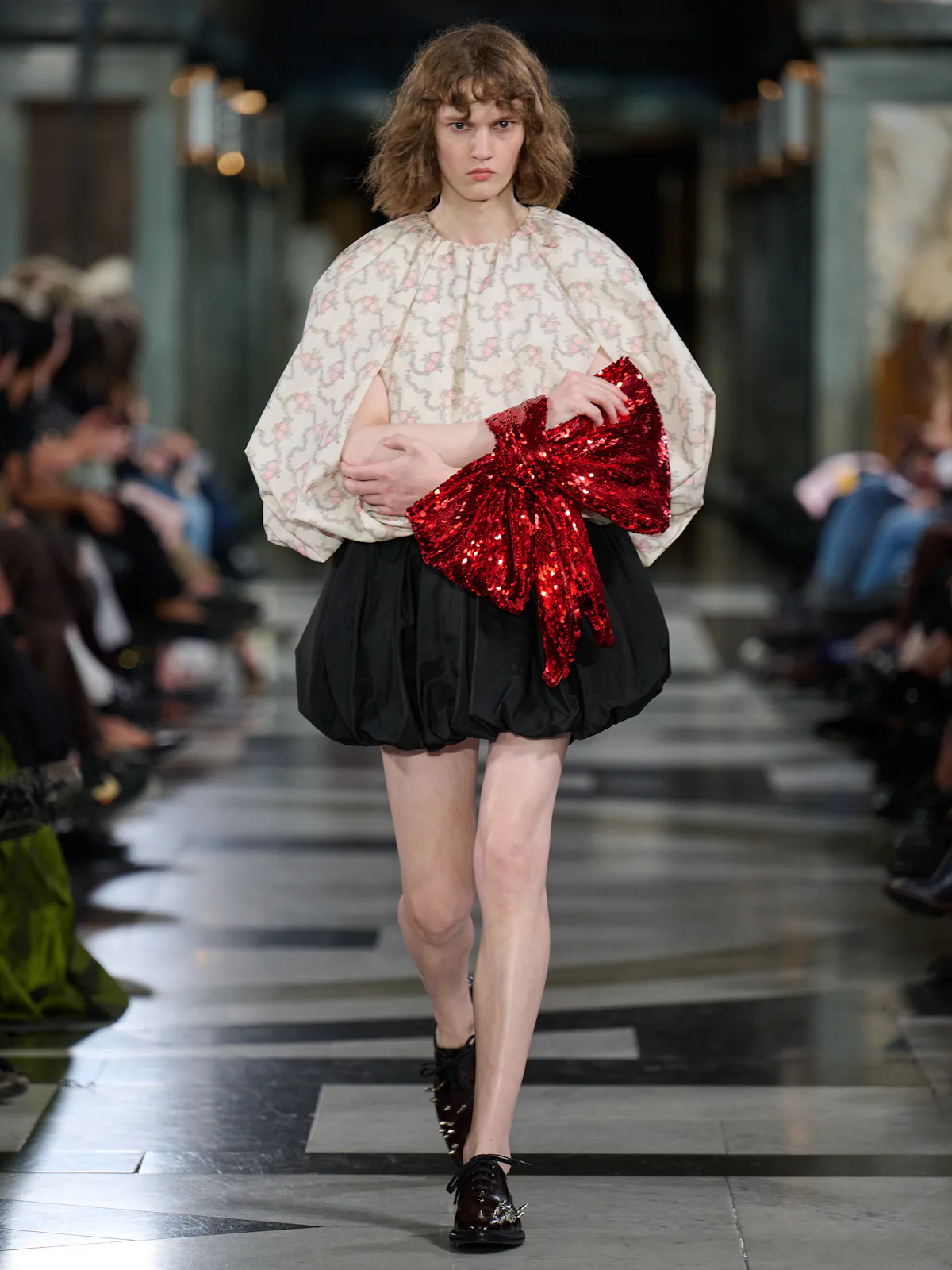
There is a particular kind of confidence that arrives when you stop explaining yourself. Simone Rocha's Spring/Summer 2027 collection, drawn from the shadowed, tenebrous world of Caravaggio, feels like that quiet arrival. The show notes carry the line, "I'm trying to love you," but as the designer herself seems to understand, there is no trying involved when the work is this assured. She has looked past the obvious drama of the 17th century, past the chiaroscuro and the religious fervor, and found something far more intimate: the beauty in an unexpected place. It is a reminder that luxury is not about volume or spectacle, but about the private resonance a piece holds before it ever meets the light.
This idea of finding the "less obvious" is one we recognize across our own style coverage. It is present in the way we look at Elevated Footwear: Defining Fall's Quietly Stylish Sneaker Selection, where the most compelling choices are not the loudest but the ones that require a second glance. It is also there in the shift toward Short nails, elevated style: Fall's manicure mood, where restraint becomes its own kind of statement. Rocha's collection operates in that same register. She is not translating Caravaggio literally; she is capturing his mood, his use of darkness to make the light feel sacred. For the woman who wears this, it is not about referencing art history. It is about understanding that true sensuality is often found in what is held back, in the tension between what is revealed and what remains covered.
What strikes us most is the emotional maturity of this approach. In a cultural moment that often confuses loudness with presence, Rocha reminds us that confidence is internal. Her work echoes the same philosophy we see in Lingerie as Layers: Daisy Edgar-Jones Redefines Modern Sensuality, where the most powerful styling comes from an inner self-possession rather than a demand for attention. This is not a collection that begs to be loved; it simply exists in its own world, and that is its quiet power. The practical takeaway for our reader is this: you do not need to chase the trend; you need to find the piece that feels like a secret you are keeping. Rocha has built an entire collection on that intimacy, and in doing so, she has given us permission to be just as selective with our own self-expression.
The detail to watch, then, is not a specific silhouette or a particular ruffle, but the way this collection asks us to reconsider what we deem precious. If Rocha can find the divine in the darkness of a Caravaggio canvas, we can learn to see the potential in the overlooked corners of our own wardrobes. The question she leaves us with is not about what to wear, but about what we choose to see in ourselves when we stop trying to perform. That is the unexpected beauty worth chasing.