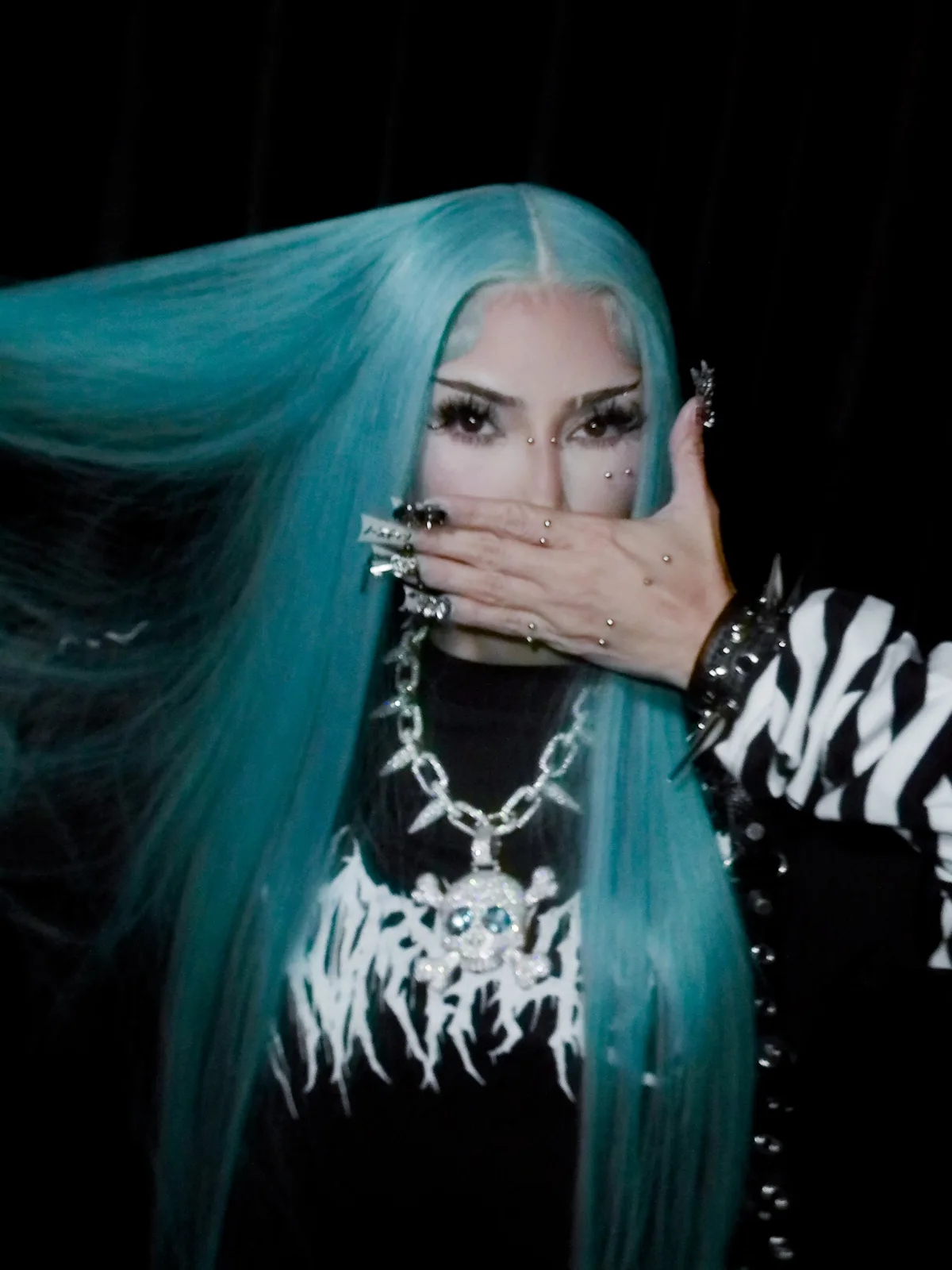
There is something quietly revealing about the way celebrities choose to transform on Halloween. When the costumes are this intentional, they stop being mere spectacle and become a kind of self-portrait. This year, what struck us most was not the prosthetic work or the shock value, but the precision of the references, each look felt less like a costume and more like a statement of identity. Kim Kardashian, for instance, did not simply dress as a character; she chose to become her daughter North West, complete with teal blue hair, faux dermal piercings, and charm-studded black nails. It was a gesture that speaks volumes about influence, legacy, and the quiet intimacy of family as muse. This is a woman who understands that the most powerful transformation is not into something foreign, but into a reflection of someone she knows intimately. It echoes the same emotional precision we admired in Amal Clooney's Emerald Moment Proves Color Is a Quiet Language, where color becomes a form of unspoken communication.
The deeper story here is about agency. These celebrities are not being cast in roles; they are casting themselves. Victoria Justice revived her "Love Zombie" party for a second year, gathering fellow actors and influencers into a cohesive world of apocalyptic glamour, her own shredded black ensemble and chain-trimmed boots evoking a controlled chaos that felt more Mad Max than monster movie. Paris Hilton, for the third time, chose to channel Britney Spears, this year the "I'm a Slave 4 U" era, complete with a python. There is a through line here: Hilton is not just paying homage; she is curating a personal mythology, one that connects her own legacy to pop culture's most defining moments. It is the same intentional self-fashioning we see in Daisy Edgar-Jones's Fall Hair Is Quiet Luxury in Motion, where every detail is chosen to reinforce a mood rather than a trend.
What makes this year's Halloween particularly compelling is the specificity. Chlöe Bailey chose Hot Meg from *Family Guy*, a cartoon character, and replicated her sartorial details almost exactly. Benito Skinner and Owen Thiele mirrored looks from Zara Larsson and PinkPantheress's "Stateside" music video. These are not generic scares or easy pop culture nods; they are deep cuts, chosen by people who know exactly what they are signaling. It suggests a cultural moment where dressing up is no longer about hiding, but about revealing a more curated version of the self. The escapism is real, but it is also precise. As we watch the holiday unfold, the question worth holding is not which costume was the most elaborate, but which one told the most honest story about the person wearing it. Because in a world where every image is a choice, Halloween has become the most honest mirror of all.