There is something deeply satisfying about watching a woman choose a bag not because it is trending, but because it belongs to her world. Zoë Kravitz, spotted on the New York set of *Die Alive* carrying a rare Fendi Baguette from the year 2000, reminds us that true style is a quiet conversation between the wearer and her wardrobe. The purse, black leather, silver hardware, a purple logo clasp, is not a statement for the cameras; it is a natural extension of the character she inhabits. This is the kind of detail that separates costume from clothing, and it aligns perfectly with the restrained, emotionally intelligent approach we explored in The Quiet Edit: Eight Ways to Celebrate the Season Without Excess. There, as here, the message is the same: refinement lives in the edit, not the accumulation.
What makes this sighting worth pausing over is not the bag's rarity or its $1,550 resale value. It is the way Kravitz pairs it with a bright yellow scarf, a black coat, and heavy heeled boots, a palette that feels intentional rather than forced. She and Riley Keough were filmed dancing and singing on a Manhattan street, and the image carries an ease that cannot be manufactured. This is the energy of someone who knows her own taste and trusts it. It echoes the same quiet nod to lineage we admired in Catherine's coat dress carries a quiet nod to Diana, an accessory becomes meaningful not because it is loud, but because it carries a story only the wearer truly knows. Kravitz's Baguette, likely sourced from the very year the bag first captured Carrie Bradshaw's imagination, speaks to a woman who understands that vintage is not nostalgia; it is a deliberate choice to wear pieces with history.
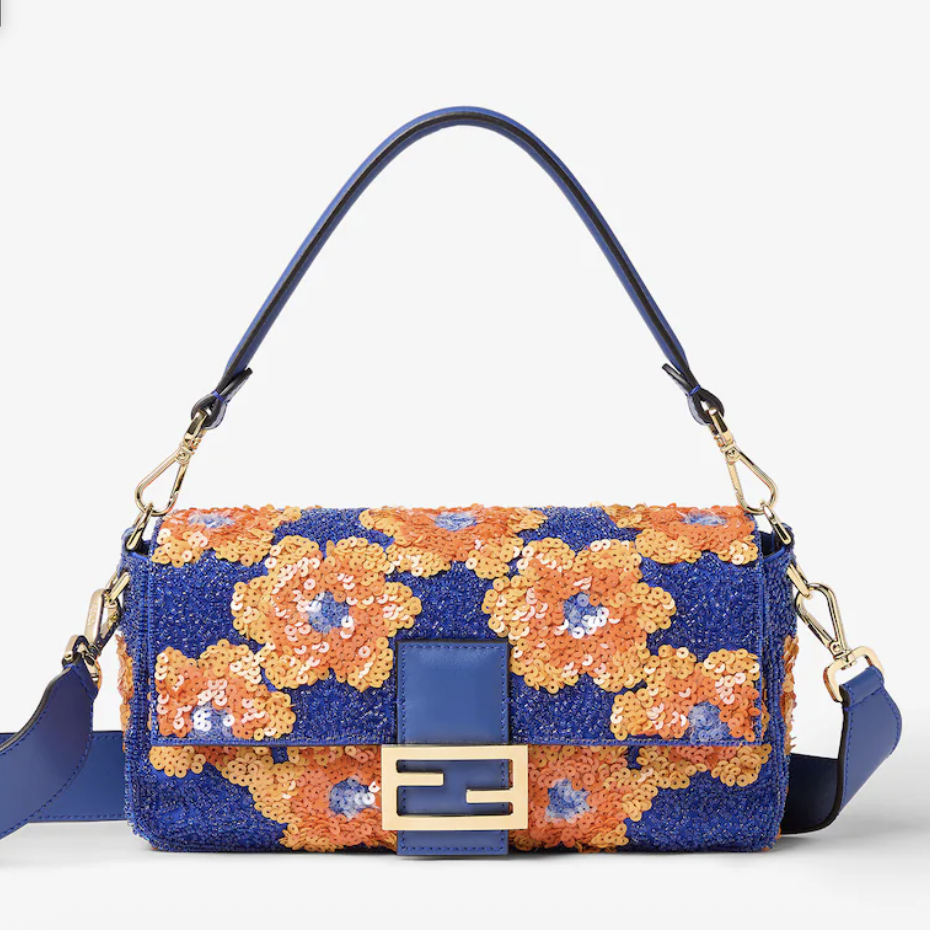
For our readers, the practical takeaway is this: let your accessories hold meaning, not just attention. A single vintage Fendi Baguette, seen here in black suede embroidered with pink and green flowers on one day, and black leather with a purple clasp on another, suggests that Kravitz's character is building a personal archive, not a collection of one-offs. That is a lesson in how to shop with intention. It is the opposite of the frantic cycle of newness, and it requires the confidence to let one item reappear in different contexts. The same sensibility that drives Emily Ratajkowski's Sheer Drape Rewrites the Naked Dress Code applies here: both women understand that impact comes from the singular, considered piece, not from volume.
The question worth watching is whether this character's wardrobe will shift the way we think about rom-com style again, much as Carrie Bradshaw did two decades ago. Kravitz is not recreating that era; she is quietly updating it for a woman who values presence over performance. If the set photos are any indication, we are about to see a new kind of leading lady, one who lets her bag do the talking, and only when it has something worth saying.