U.S. Deploys World’s Largest Aircraft Carrier USS Gerald R. Ford to Red Sea After Record 297-Day Mission
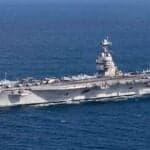


The United States has sent its largest aircraft carrier, USS Gerald R. Ford, back to the Red Sea, bringing back a major naval strike capability in a region where tensions remain high.
Two defence officials confirmed that the carrier has resumed operations under US Central Command after passing through the Suez Canal late last week.
The carrier had left Split, Croatia, on 2 April after completing repair work linked to a fire that broke out on board on 12 March.
The fire started in a laundry area and caused injuries and some internal damage, but it did not affect the ship’s propulsion or combat systems.
Before returning to operations, the vessel spent more than a month at Souda Bay in Greece.
USS Gerald R. Ford is about 1,106 feet long and displaces over 100,000 tonnes, making it the largest warship in the world. Officials said the carrier is now fully ready for missions.
The redeployment places the carrier back into an active operational zone. It is not operating alone.
The USS Abraham Lincoln Carrier Strike Group is already in the region and has been there since January. The USS Tripoli Amphibious Ready Group is also deployed, along with USS New Orleans and USS Rushmore.
USS Mahan and USS Winston S. Churchill escorted Ford through the Suez Canal into the Red Sea.
These destroyers add air defence, missile defence, and anti-submarine capabilities to the group. Another carrier, USS George H. W. Bush, is also heading towards the Middle East after sailing around the southern tip of Africa.
USS Gerald R. Ford has already been at sea for 297 days, making this one of the longest deployments for a US aircraft carrier in recent decades. Officials said the mission could last around 11 months.
The carrier left Naval Station Norfolk in June 2025 and has been moved between different regions since then. It first operated in the Caribbean in missions linked to Venezuela before shifting to the Middle East.
The carrier carries more than 75 aircraft, including F/A-18 Super Hornet fighter jets, EA-18G electronic warfare aircraft, and E-2D early warning aircraft.
These allow the ship to carry out air operations, surveillance, and strike missions over a wide area.
Its position in the Red Sea gives it reach over key maritime routes such as the Bab el-Mandeb Strait and the southern end of the Suez Canal.
These are among the busiest shipping lanes in the world, with large volumes of oil and cargo passing through them every day.
USS Gerald R. Ford is fitted with systems such as the Electromagnetic Aircraft Launch System and advanced arresting gear, which help launch and recover aircraft more efficiently.
It also has modern radar and command systems that support operations in areas where missile and drone threats are present.
The destroyers sailing with the carrier use the Aegis Combat System and Standard Missiles, providing protection against air, missile, and underwater threats.
Together, the carrier and its escorts form a layered defence setup that allows operations in contested waters.
References: Interestingengineering, armyrecognition
Want to read more?
Check out the full article on the original site