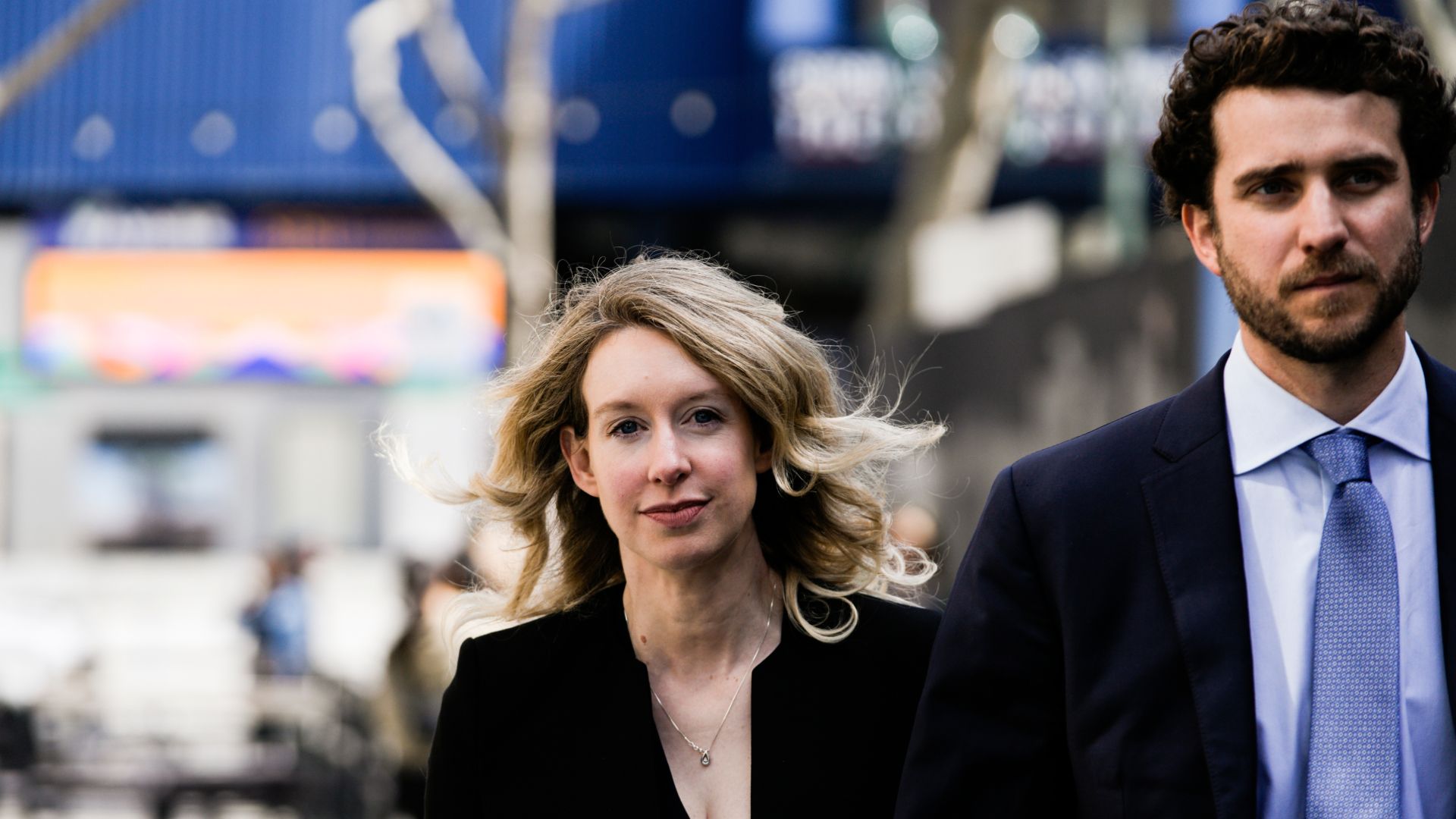
There is something more disturbing in *You Can See Everything* than Elizabeth Holmes's fraud, and that is the quiet, devoted man who has begun to wear her life like a coat. The documentary, a collaboration between Nathan Fielder and Lance Oppenheim, arrives as the latest chapter in a story that has already been told through books, series, and films, yet it manages to find a new subject: not the disgraced founder, but the partner who stayed. Billy Evans did not simply support Holmes through her trial and imprisonment. He has, in her absence, begun to reconstruct her, controlling her social media, managing an AI model of her voice and image, and telling the camera he can "literally do anything" with her likeness. It is a performance of devotion so complete that it becomes indistinguishable from possession. We have seen this dynamic before, of course, in quieter forms. The Quiet Habit That Moves Queen Camilla to Tears reminds us that even the most visible public figures carry private grief that surfaces in unexpected ways, but here the grief is not the story, ambition is. Evans has founded a diagnostics startup called Haemanthus, Greek for blood flower, while Holmes advises him from her prison cell. The symmetry is not lost on anyone.
What makes this film unsettling is not the obvious parallel to Theranos, which the company denies, but the way it forces us to reconsider the mythology we have built around Holmes herself. We have spent a decade dissecting her: the turtleneck, the baritone, the girlboss rise and the conviction. We have dramatized her, memed her, reduced her to a cautionary tale about female ambition. Yet the men beside her have always been supporting characters in her story, first Ramesh "Sunny" Balwani, now Evans. The documentary flips this framing. Once Holmes walks into prison, the film becomes a study of the man left behind, and what he does with her absence becomes far more interesting than what she did with her power. Evans tells Fielder he knew she might be scamming him when they met. He negotiated a share of the documentary's profits while she was out of the room. He describes her as "weird" to her face and takes the whisk out of her hand to finish cooking. These are small acts of control dressed as care, and they accumulate into something that recalls Alfred Hitchcock's *Vertigo*: a man so consumed by his idea of a woman that he begins to rebuild her, voice and all. An Insider’s Influence Now Faces Its Most Public Reckoning examines how power operates through proximity and loyalty in the royal household, and the same question applies here: who is really driving when a man speaks for a woman who cannot speak for herself?
The clearest takeaway from *You Can See Everything* is that male ambition operates most freely when it is dressed as belief in a woman. Evans does not need to be a villain in the traditional sense. He seems sincere in his love, and that sincerity is precisely what makes the film so queasy. He is not performing devotion to deceive anyone; he is performing devotion because he believes it is his role, and that belief gives him license to act as gatekeeper, translator, and even owner of her legacy. Holmes built the lie, and a jury said so. But the documentary suggests that even a woman who catastrophically abused her own power can become raw material for someone else's reinvention. The blood lily blooms before its leaves appear, bare and exposed, and the name of Evans's company invites the comparison. A Palace in Motion: Charles Supports a New Tribute to Diana’s Legacy shows how legacy can be shaped by those who remain, but the question here is sharper: what happens when the person shaping the legacy is the same person who stands to inherit it? Evans now raises their two children alone, moves to Texas to be near her facility, and builds a blood-testing company from the wreckage of the most famous blood-testing fraud in history. The flower is visible, but the roots remain buried.