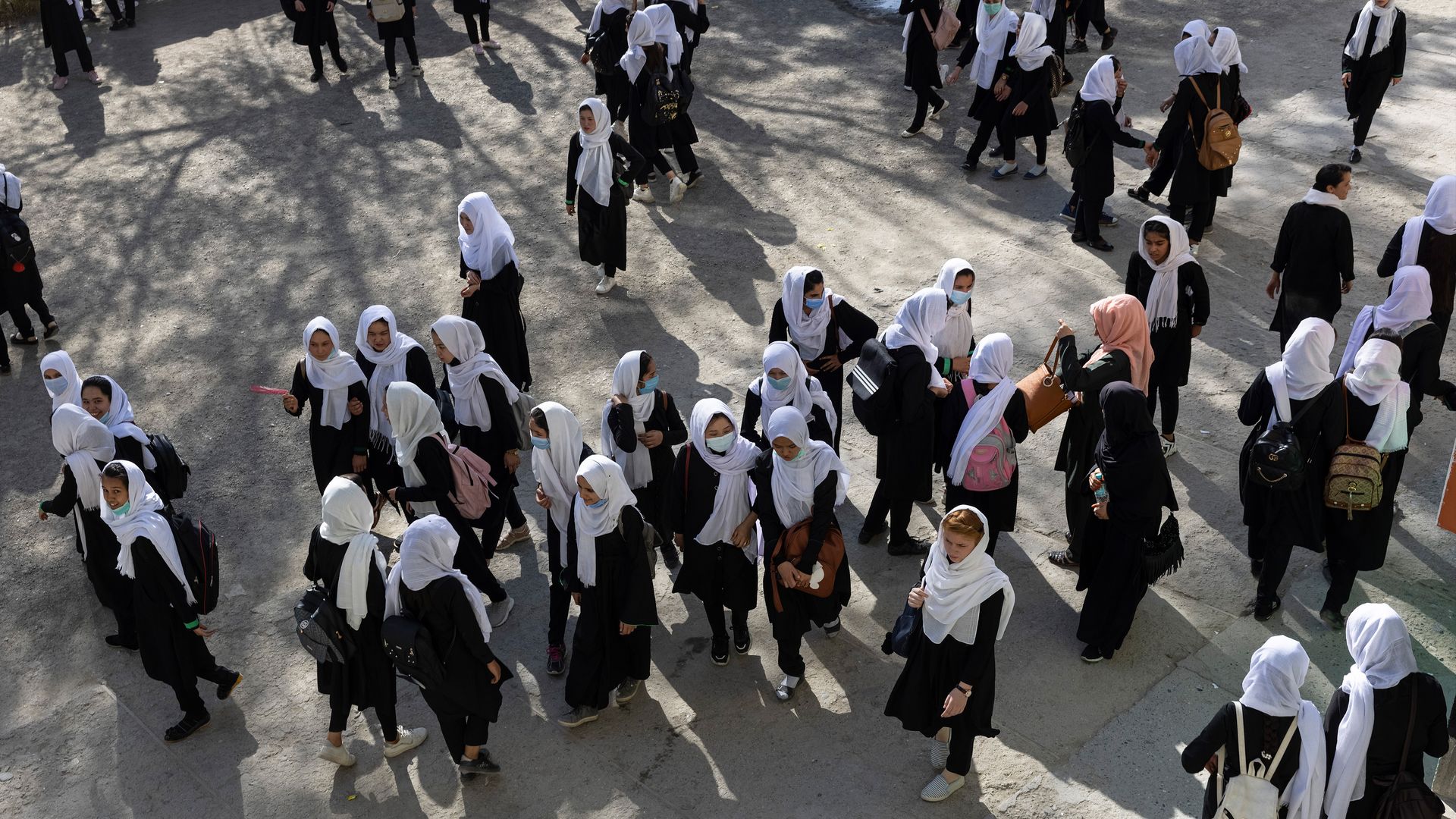
There is a particular kind of quiet that settles over a place where girls have been erased from public life. Sinah noticed it in Ghazni province, the absence of women on the streets, and she typed a poem about it on her phone, a small act of defiance against a regime that would punish her for the words alone. This is the reality five years after the Taliban banned girls from education in Afghanistan, and it is the reason we must talk about what is happening in a former hotel on the leafy outskirts of Kigali, Rwanda. The School of Leadership, Afghanistan (SOLA) is the world's only boarding school for Afghan girls, operating in exile, and it represents something far more radical than a classroom: it is a refusal to let the future be stolen. In a media landscape that often trades in the trivial, Prince Archie's School Choice Skips One Subject, Harry Reveals or Why Heels Deserve a Place in Your Everyday Wardrobe, this story demands a different register. It asks us to look at what happens when education becomes an act of survival.
Our take is this: SOLA is not a charity project; it is a statement of intent about what femininity and power can look like when they are rooted in self-determination rather than permission. Shabana Basij-Rasikh, the school's 36-year-old founder, knows this intimately. She was six when the Taliban first took power, and she spent nearly six years studying in disguise, dressed as a boy to escort her sister to illegal schools in Kabul. That experience did not make her bitter; it made her deliberate. She cofounded SOLA at 18, first as a small tutoring program, then as a boarding school in Kabul, and now as a full compound in East Africa where 118 girls live and learn in a space that feels, on the surface, almost ordinary, science classes dissecting chickens, art rooms with Taylor Swift paintings, fingers stained with henna after Ramadan. But there is nothing ordinary about a school whose students cannot post on social media, whose families back home have been taken by the Taliban, and whose futures rest on "time, patience, and Shabana-jan." The quiet luxury here is not aesthetic; it is the luxury of a life built on conviction rather than circumstance.
For our readers, the practical meaning is clear: the most powerful form of confidence is often the one that does not announce itself. Sinah, now a student at SOLA, did not scream for attention when she crossed the border on foot, sinking into the sand, climbing mountains in the dark. She simply decided that her education was worth the risk. That is the same energy Shabana Basij-Rasikh brings to her work, a soft voice, a throaty laugh, and an unshakable belief that educating girls is a direct threat to authoritarian power. This is not a story about victimhood; it is about agency exercised under conditions most of us will never face. The school's students have made a choice that means they may never return to Afghanistan, and they carry that weight with a composure that feels almost gravitational. They remind us that refinement is not about what you own, but about what you refuse to surrender.
The open question that lingers is whether the world's attention will hold. The Taliban's grip has only tightened, and SOLA operates in a state of permanent exile, its students banned from even sending photographs home without each file stripped of its metadata. As other headlines shift toward the mundane privileges of royal schooling or the styling of a heel, we must ask what it means to look away. The detail to watch is not a statistic, it is the fact that none of these students have returned to Afghanistan. Their futures rest on three things: time, patience, and a woman who once wore a boy's clothes to learn to read. That is not a metaphor. That is the quietest, most formidable kind of power there is.