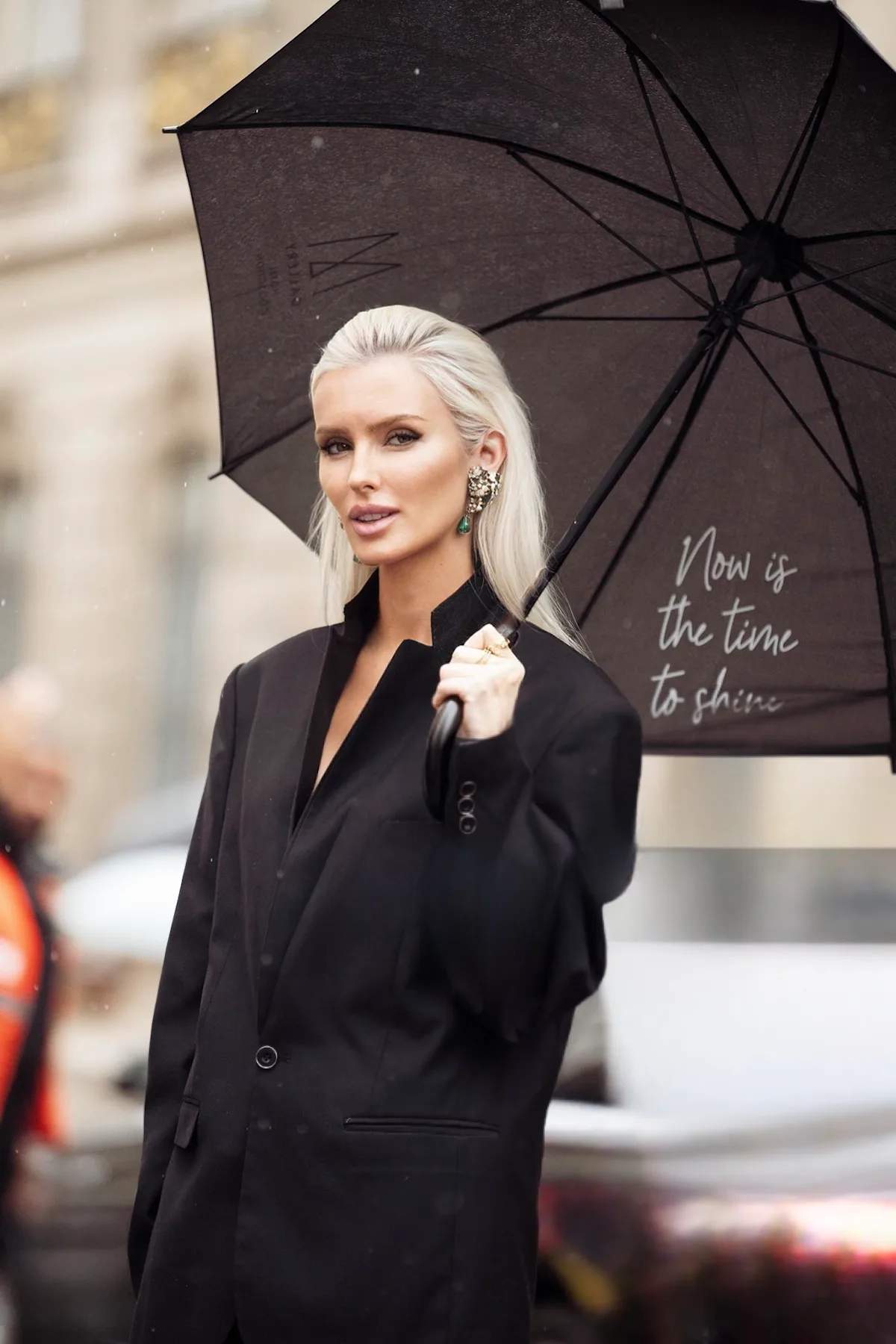
There is something quietly radical about a woman who treats her own closet as both a sanctuary and a system. Kate Davidson Hudson, the editor and founder of Vetir, does not present her wardrobe as a collection of possessions but as a living archive of intention, one she now manages with the help of her own AI stylist. This is not the chaotic, trend-chasing consumption we have grown accustomed to; it is editing as a form of self-knowledge. We have explored similar territory in The Quiet Ascent of Denim into Modern Luxury, where we traced how even the most casual fabric can be elevated through precision and restraint. Hudson's approach feels like the logical next step: if denim can be luxury, then surely the act of getting dressed can be refined into a ritual, one where technology serves the eye rather than replacing it.
What strikes us most is not the app itself, but the philosophy beneath it. Hudson describes her default style algorithm as a "masculine-feminine balance," anchored by a well-tailored suit or YSL's Le Smoking as her version of the little black dress. This is not a woman chasing novelty; she has found her shape and simply refines it. The Khaite jacket that "has a certain rigor but still feels sensual," the low-slim trousers that remove formality from tailoring, the Jennifer Fisher ring that elevates without announcing itself, these are pieces chosen for their quiet authority. In an era when dressing often feels like performance, there is a deep calm in watching someone who has already decided who she is. That same calm surfaces in Maike Inga at Villa Volman in refined coats and quiet tailoring, where the silhouette itself becomes the statement. Hudson shares that sensibility: the body is not hidden or shouted over, but respected.
The practical takeaway here is not that we all need an AI stylist, but that we need a clearer sense of our own default. Hudson's method, laying everything out, photographing it, adjusting the shoe until the whole outfit recalibrates, is a physical discipline that any of us can borrow. She is not overwhelmed by her choices because she has built a framework for them. The GRLFRND bodysuit she wears under a tuxedo jacket, severe until the jacket comes off, is a perfect metaphor: the surprise is not in the garment but in the reveal, the moment when structure gives way to softness. That duality, the confidence to be both tailored and undone, is what makes her style feel lived-in rather than staged. It is also what makes Vetir feel less like a gimmick and more like a mirror. Hudson is not selling us the app; she is showing us how she uses it to stay connected to her own taste. The distinction matters.
What remains to be seen is whether this kind of curated calm can scale. Hudson developed her eye over years as an editor; her algorithm is trained on her own history. For those of us still searching for our Le Smoking, the question is not whether the technology works, but whether we know ourselves well enough to feed it the right data. That is the detail worth watching: not the next feature launch, but whether Vetir can teach discernment as effectively as it teaches organization. Because a digitized closet is only as good as the woman who edits it.