There is something quietly radical about two women who refuse to compete for the spotlight. Governor Kathy Hochul and Adrienne Adams are making a case for a different kind of political power, one that feels less like a blood sport and more like an old friendship. In an exclusive joint interview with Marie Claire, they finish each other's sentences, laugh easily, and talk about governance as collaboration rather than conquest. It is a refreshingly understated approach in a moment when so many leaders seem to be auditioning for the loudest room in the house. This is not the kind of story that screams for attention, and that is precisely what makes it worth paying attention to. It echoes the same refined, intentional energy we explored in The Art of Understated Giving: 75 Gifts That Feel Worth More, where value is felt, not announced. And like the quiet confidence of Four widths, one refined silhouette for the modern woman, this ticket suggests that power, too, can be tailored to fit without needing to shout. What Hochul and Adams are betting on is that the public is exhausted by conflict dressed up as strength. Hochul has spent her first term explicitly rejecting the model of governor-versus-mayor, executive-versus-legislature, ego-versus-ego. Instead, she has leaned into a philosophy that treats governing relationships as assets rather than obstacles. The most visible proof is her partnership with Mayor Zohran Mamdani, a democratic socialist who, by conventional logic, should be her natural antagonist. On his eighth day in office, they announced free childcare for two-year-olds in New York City. The initiative is part of a $1.7 billion statewide increase in childcare and pre-K funding, a policy born not from political convenience, but from lived experience. Both women know what it means to make impossible calculations between career and care. Hochul remembers the moment her dream job became unsustainable after her son was born, the coupons and the bulk diapers in a small apartment. Adams became an "instant mother of four" in 1989, and decades later, one of those children moved her own family to Delaware because New York had become too expensive to raise kids in. "We lost them to Delaware," Adams says. Hochul cuts in: "Until now." The childcare program is the clearest test of what their version of government is supposed to accomplish. Next fall, it will expand from roughly 2,000 seats to more than 12,000 across all five boroughs, with citywide universality as the goal. Nearly three families applied for every available seat in its inaugural round. That demand is not abstract: a mother at a Brooklyn rally told the crowd that with her son now in 2-K, her family is finally saving for a home. The line between childcare policy and housing policy gets thin fast. But the appetite is already outpacing the infrastructure, and the risks are real. Hochul's Republican opponent has called the program "overexpensive" and suggested it should be limited to working parents who can prove their employment with tax returns. Meanwhile, the Trump administration froze $10 billion in childcare and social services funding for five Democratic states earlier this year, a freeze that was only blocked by a lawsuit and later rescinded in July. The question of whether this experiment can survive the next election, or the next federal budget, is not rhetorical. What makes this ticket compelling is not just the history it would make, but the quiet argument it is making about how to govern. Hochul and Adams are not promising to be the loudest voices in the room. They are promising to be the most effective ones, and they are betting that collaboration, not confrontation, is what actually gets things done. For our readers, the takeaway is specific: watch what happens when childcare is treated as public infrastructure rather than a private family burden. If New York can make this work at scale, it becomes a test case for every expensive city in the country. If it cannot, the reasons will tell us something about the limits of even the most well-intentioned collaboration. Either way, the story is not about who wins the press conference.
brand collaborations
The Quiet Power of Hochul and Adams' All-Woman Vision for New York
Governor Kathy Hochul and Adrienne Adams sit for an exclusive joint interview, and the image is striking, two women at the helm of New York's first all-woman ticket, quietly redefining what leadership looks like.
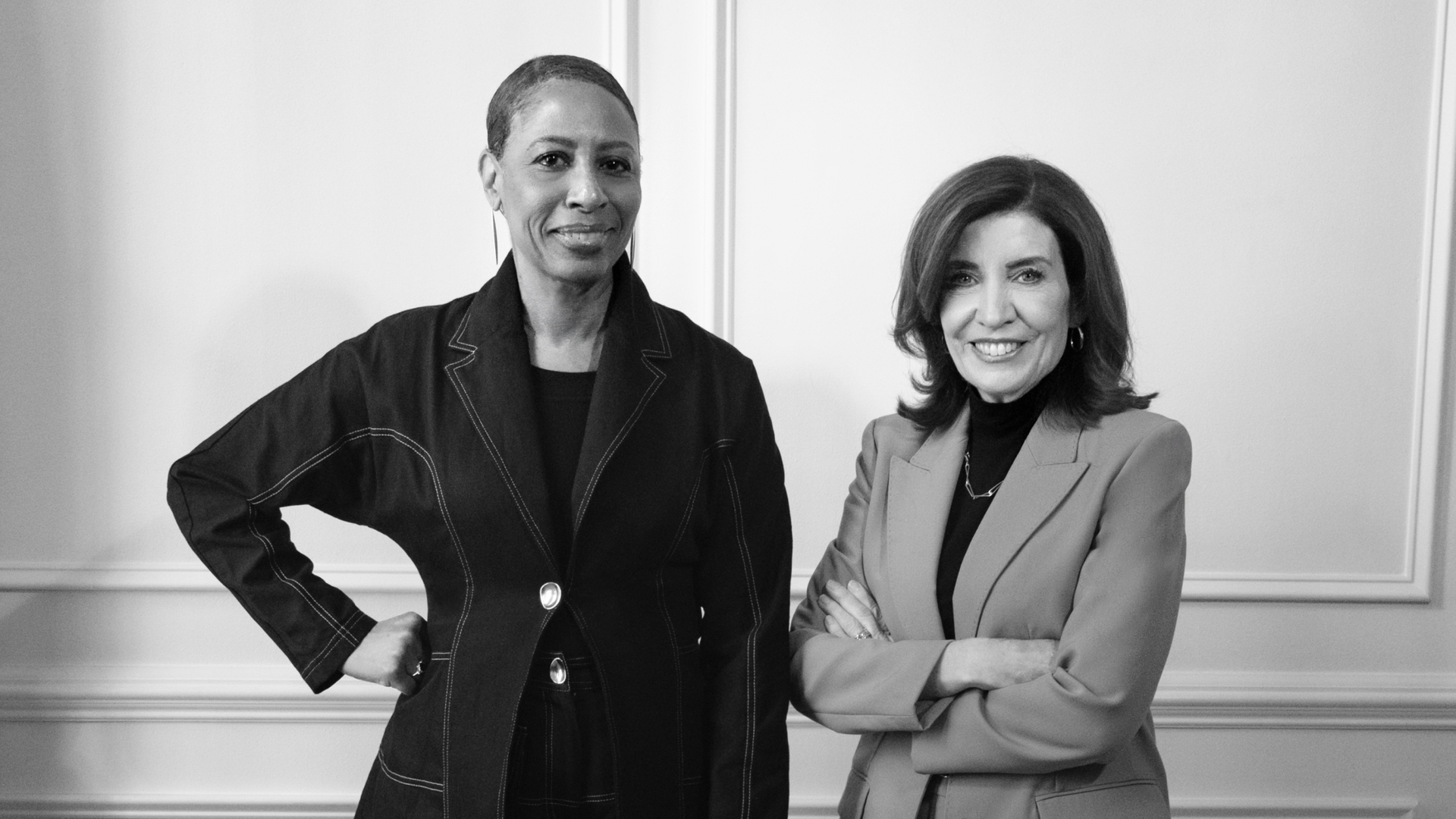
A week before New Yorkers decide whether to send them to Albany together, Gov. Kathy Hochul and Adrienne Adams can’t stop finishing each other’s sentences. Sitting side by side in a Midtown studio on a Monday afternoon, they talk over and around each other like old friends who have long stopped waiting politely for the other to finish. If they win on November 3, they would make up the first all-female gubernatorial ticket in New York history, and Adams, the former City Council speaker, would become the first Black woman elected lieutenant governor of New York. But for all the…